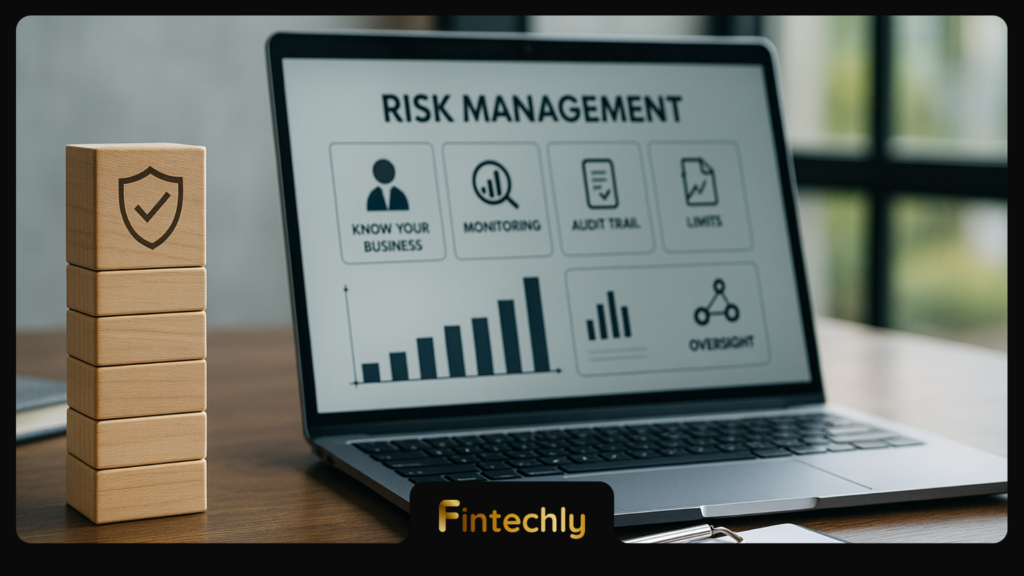
Sponsor banks sit at the center of many fintech and embedded finance programs. Regulators expect the bank to stay in control, even when a partner runs the day to day work. That is why risk management for sponsor banks must be clear, tested, and enforced from onboarding to ongoing monitoring.
Why sponsor bank programs draw extra scrutiny
A sponsor bank may offer accounts, payments, cards, or lending through a program manager or fintech. This can scale fast. It can also scale risk fast.
Supervisors focus on one simple point. The bank cannot outsource responsibility. The bank must prove it can see what is happening and stop what should not happen.
The control stack regulators expect to see
Strong programs use layers. Each layer reduces risk on its own. Together, they prevent weak points from becoming failures.
- KYB and due diligence to know who is in the program.
- Ongoing monitoring to spot unusual activity early.
- Audit trails so actions and decisions can be replayed and tested.
- Limits and guardrails to cap exposure.
- Oversight and governance to keep accountability inside the bank.
1) KYB and onboarding controls (who is allowed in)
KYB matters because sponsor bank programs often serve business customers and sub-merchants. You need to know who is behind a legal entity. You also need to know what they will do with the bank’s rails.
What good KYB looks like
Controls should be simple and consistent. They should not depend on a single vendor output.
- Business identity checks (legal name, registration, tax ID, address, status).
- Beneficial owner and controller checks, based on the bank’s policy and the product.
- Nature of business review with clear high-risk categories and escalation rules.
- Sanctions screening for entities and key people.
- Expected activity profile (volumes, geographies, counterparties, channels).
Common KYB weak points regulators flag
- Relying only on partner-collected data with no bank validation.
- No clear policy for rejected applicants and re-tries.
- No proof of review steps. No timestamps. No reviewer identity.
- Inconsistent treatment across similar customers.
KYB should connect to the rest of the program. If the onboarding says “low risk,” monitoring should not treat the customer as “unknown.” Link the profile to the rules and alerts.
2) Ongoing monitoring (what is happening now)
Monitoring is where sponsor banks win or lose trust. Regulators want timely detection, real investigation work, and clear outcomes.
Financial crime monitoring
This includes AML, fraud, and sanctions. It should cover payments, transfers, card activity, cash-like features, and partner-controlled flows.
Many programs improve by aligning with proven sponsor bank financial crime controls that combine onboarding signals with live behavior.
- Rule-based and behavioral alerts tuned to the product.
- Velocity checks to catch sudden spikes.
- Geo and IP signals to flag risky access patterns.
- Sanctions and watchlist re-screening at set intervals and on events.
- Case management with notes, evidence, and decision tracking.
Data quality is a control
Monitoring breaks when data is late, missing, or changed without notice. Regulators expect the bank to manage data risk, not just “buy a tool.” Using integrated data for AML monitoring can help reduce gaps between partner systems and bank systems.
- Data maps that show each field, source, owner, and update timing.
- Reconciliation checks between ledger, processor, and partner records.
- Change control for schema updates, new event types, or new processors.
3) Audit trails and recordkeeping (prove what you did)
A strong audit trail is not optional. It is how you show control. It should cover customer actions, partner actions, and bank decisions.
Minimum audit trail items
- Who took the action (user, system, partner role).
- What changed (field-level where possible).
- When it happened (with time zone and sequence).
- Why it happened (case link, policy link, approval reason).
- Evidence attached (documents, screenshots, logs, alerts).
Keep logs tamper-resistant. Limit who can edit them. Test retrieval. In an exam, “we can pull it if needed” is not enough. You must show you can pull it fast.
4) Limits and guardrails (cap your exposure)
Limits reduce damage when controls miss something. They are also easier to test than judgment-based reviews.
Limit types sponsor banks should set
- Customer limits (daily and monthly volume, transaction size, cash-out, chargeback rate triggers).
- Program limits (total exposure by product, corridor, or partner).
- Velocity limits (number of attempts, failed auth, retries).
- Geography limits (blocked countries, restricted corridors, high-risk regions).
- Risk-based step-up (extra checks when activity moves outside the expected profile).
Make limits enforceable
Limits should be enforced at the point of transaction when possible. If a limit only creates a report days later, it is not a real guardrail.
5) Oversight of fintech partners and program managers (third-party risk)
Partner oversight is a core part of risk management for sponsor banks. It is also where many programs fail. Banks often approve a partner, then stop testing them.
Use a structured third-party program that aligns with regulatory expectations such as the OCC third-party risk management guidance.
Key oversight controls
- Clear contracts with service levels, audit rights, and data access rights.
- Defined control ownership (what the partner does, what the bank does, what is shared).
- Ongoing testing of key controls, not just annual questionnaires.
- Issue management with deadlines, owners, and proof of fix.
- Exit plans that include customer communications and data retention.
What oversight looks like in practice
Regulators expect more than meetings and decks. They expect evidence.
- Sample reviews of onboarding files and exception approvals.
- Alert QA and investigator QA with scored results.
- Periodic re-KYB reviews for higher risk segments.
- Processor and partner reconciliation testing.
6) Technology controls that support compliance (security, access, change control)
Many sponsor bank program failures start as tech issues. A weak integration can create blind spots. Poor access controls can lead to fraud or data leaks.
Focus on basics. Then test them. Program teams should also treat API security for banking-as-a-service programs as a compliance control, not only an IT topic.
Core technology controls
- Least privilege access for bank and partner users.
- Strong authentication for admin actions and sensitive workflows.
- Segregation of duties (no one person can onboard, approve, and release funds).
- Secure logging with alerting on log gaps and anomalies.
- Change management for code, rules, and risk models.
- Incident response playbooks with joint bank-partner drills.
7) Governance and reporting (who is accountable)
Governance turns controls into a system. It sets who owns risk decisions and how the bank learns from issues.
Three lines that actually work
Keep roles simple. Avoid overlap and gaps.
- Line 1: program and operations teams run the controls daily.
- Line 2: compliance and risk set policy, challenge, and test.
- Line 3: internal audit validates the full design and performance.
What regulators expect in board and senior management reporting
- Customer growth and concentration by partner and product.
- Alert volumes, backlogs, and closure times.
- SAR-related metrics where applicable, and escalation outcomes.
- Fraud loss rates, dispute rates, and complaint trends.
- Limit breaches and overrides, with reasons.
- Open issues, repeat issues, and overdue fixes.
8) Independent testing and audits (trust but verify)
Independent testing is how you prove controls work. It also forces consistent documentation.
For AML and related controls, many banks align testing to the FFIEC BSA/AML Examination Manual to ensure coverage is complete.
What to test
- KYB file quality (samples across risk tiers and partners).
- Monitoring effectiveness (alert-to-case rates, true positive rates, missed scenarios).
- Sanctions screening (list updates, matching logic, false positive handling).
- Audit trail integrity (can you reconstruct a customer journey end to end).
- Limit enforcement (are limits applied in real time and consistently).
Putting it together: a simple sponsor bank control checklist
Use this as a starting point. Tune it to your products and jurisdictions.
- KYB: verified business identity, owners, purpose, expected activity.
- Monitoring: coverage for all rails, clear alert handling, tested rules.
- Audit trails: complete logs, tamper-resistant, easy retrieval.
- Limits: customer and program limits, real-time blocks, override tracking.
- Partner oversight: audit rights, testing plan, issue tracking, exit plan.
- Security: access control, change control, incident response drills.
- Governance: clear owners, board reporting, independent audit coverage.
Regulators do not expect perfection. They expect clear ownership, strong basics, fast issue fixes, and proof.
FAQs
What is the main goal of risk management for sponsor banks?
The goal is control. The bank must be able to prevent, detect, and correct problems across the full program. This includes the partner’s work, not just the bank’s internal work.
Which controls get the most attention in exams?
KYB quality, transaction monitoring, sanctions screening, partner oversight, and audit trails. Examiners also focus on how fast issues are found and fixed.
How often should a sponsor bank review a fintech partner?
At onboarding, then on a set schedule, and also after major changes. Triggers include new products, new processors, rapid growth, spikes in fraud, or repeated control breaks.
What is a red flag that a program is out of control?
Large alert backlogs, unclear ownership of investigations, missing logs, frequent limit overrides, and weak data reconciliation. Rapid growth with no added staffing is also a common warning sign.
Do limits replace monitoring?
No. Limits reduce exposure. Monitoring finds patterns and hidden risk. Strong programs use both, with clear escalation and action steps.