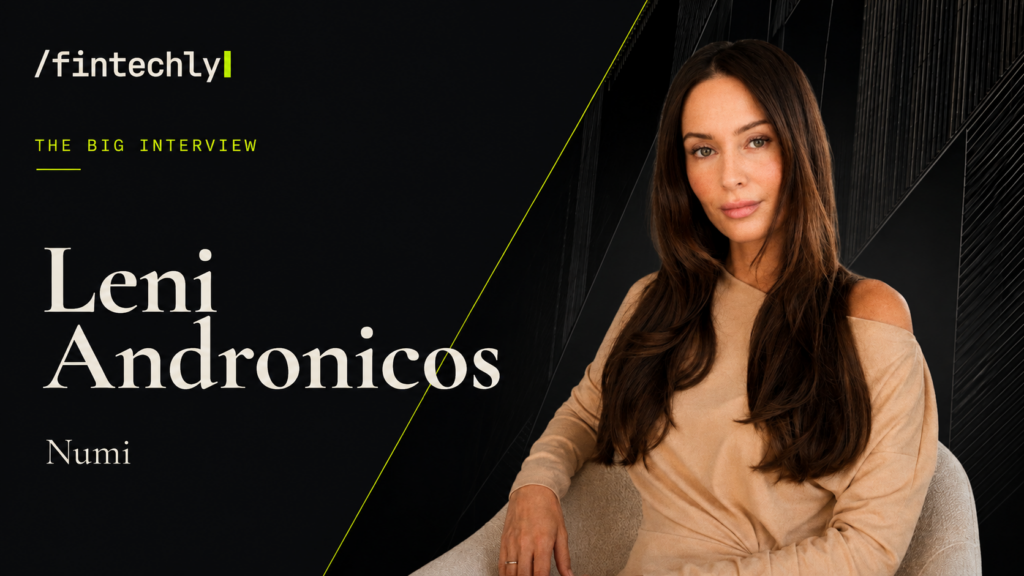
There’s a particular kind of confidence that comes from having built consumer loyalty before, at scale, more than once. Leni Andronicos has it. The Numi co-founder spent her career getting people to fall for brands like Spotify, American Express and MTV long before she decided the next thing worth falling for wouldn’t be a product you open at all.
Numi is betting on something almost contrarian in fintech: an AI-native financial agent built to be used as little as possible. Working within the UAE’s Al Tareq Open Finance regulatory sandbox as it pursues a Third-Party Provider licence, Numi doesn’t just recommend what to do with your money; it acts, executing decisions directly within boundaries the user sets in advance.
Andronicos built the brand instincts. Her co-founder, ex-Citibank VP of Technology Usman Azim, built the guardrails. Somewhere in the tension between the two is a company trying to prove that the most powerful brand relationship isn’t the one you check obsessively, it’s the one you trust enough to stop checking at all.
We spoke to Andronicos about building emotional loyalty to something invisible, the psychology of handing over the wheel, and what she’s learned about disruption after a decade of building brands.
You’ve scaled iconic platforms like Spotify and MTV. How did those experiences influence the building of emotional loyalty to Numi?
Leni Andronicos: Loyalty comes from people feeling like you get them. Nobody is in love with Spotify’s recommendation algorithm itself; they are in love with the fact that it just knows what they want to hear. That’s really what I brought to building Numi. We’re not selling ‘automation.’ We’re selling that same feeling, that this thing actually knows your life and cares about your goals and dreams.
While fintech usually prizes daily usage, Numi aims to minimise time in-app. How do you build a top-tier brand when the product works autonomously behind the scenes?
Leni Andronicos: For us, it’s trust, and trust gets built in the moments you’re not looking, not the moments you are. Our brand value lives in the outcome we produce. Did the rent get covered before it was due? Did you actually earn more on your savings while you were asleep?
You don’t want to be reminded it exists; you want to feel it working. The old fintech playbook says to build a habit loop. We’re building an absence loop; the less you have to think about us, the harder we’re actually working. That’s a completely different brand-building exercise than anything I’ve done in my career, and honestly, it’s the more interesting problem. Anyone can build a brand people check ten times a day. Building one person’s trust without checking is a harder thing to pull off.
There is a massive psychological leap between letting an AI recommend a playlist on Spotify and letting an AI agent autonomously move your money to optimise yield. What is the UX secret to closing that trust gap for consumers who are hesitant to give up the steering wheel?
Leni Andronicos: Honestly, people aren’t scared of the AI part. They’re scared of not knowing what it’s allowed to do. So we just make that really simple up front. You tell Numi, don’t let my balance drop below this, always ask me before you touch that account, stuff like that. Once you’ve set those rules, you’re not really “trusting the AI” anymore; you’re just letting it do the job you already told it to do.
If Spotify picks a bad song, whatever, skip it. If an AI moves your rent money wrong, that’s a real problem. So we’re not trying to pretend that’s not a big deal. We just make sure you’re the one setting the limits first. Once people have that, the fear kind of goes away on its own.
You paired your consumer-first, brand-building instincts with your co-founder Usman Azim’s heavy institutional background in Citi’s global risk infrastructure. Where do your two mindsets clash productively, and how did that friction form Numi’s security framework?
Leni Andronicos: We joke about this all the time, actually. I’m the ‘go go go’ founder and he’s the ‘no no no’ founder. He basically holds the reins on me. I’ll come in with some big idea, some grand vision of what this could be, and he’s the one who just calmly goes, okay, but here’s how that breaks, here’s what the regulator’s going to ask, here’s why we can’t ship that yet. And honestly, I need that.
So it’s not really friction in a bad way; it’s more like he’s the ground and I’m the reach. I bring the vision; he brings the ‘let’s make sure this doesn’t blow up’ part, and whatever survives that back-and-forth is usually the right version.
Looking at the macro shift toward AI-native software, how has your own personal philosophy on what makes a product ‘disruptive’ evolved over the last decade?
Leni Andronicos: Three years ago, I would’ve said disruptive just meant a faster, cheaper, better version of something that already existed. I don’t think that anymore. And that’s kind of the whole problem with AI right now: it’s really good at building things that already exist. Ask it for a better budgeting app, and it’ll give you one. What it can’t do is sit there and go, wait, why does this need to exist at all? Who’s it actually for? Why now. That part’s still human. It takes someone to look at a mess nobody’s solved properly and decide what should be built, not just how to build it faster.
So for me, disruptive doesn’t mean a better tool anymore; it means the task disappears completely. Nobody actually wants to sit there managing their money; they just want it managed. And I think that’s the real shift coming. The most disruptive stuff over the next three years won’t feel like smarter software. It’s going to feel like something you used to have to do yourself, just quietly, isn’t there anymore. AI can help build that once someone’s figured out it needs to exist. But figuring out that it needs to exist in the first place, that’s still on us.
Also, read DDSC Dirham Stablecoin Gets Central Bank Approval for VARA Exchanges