

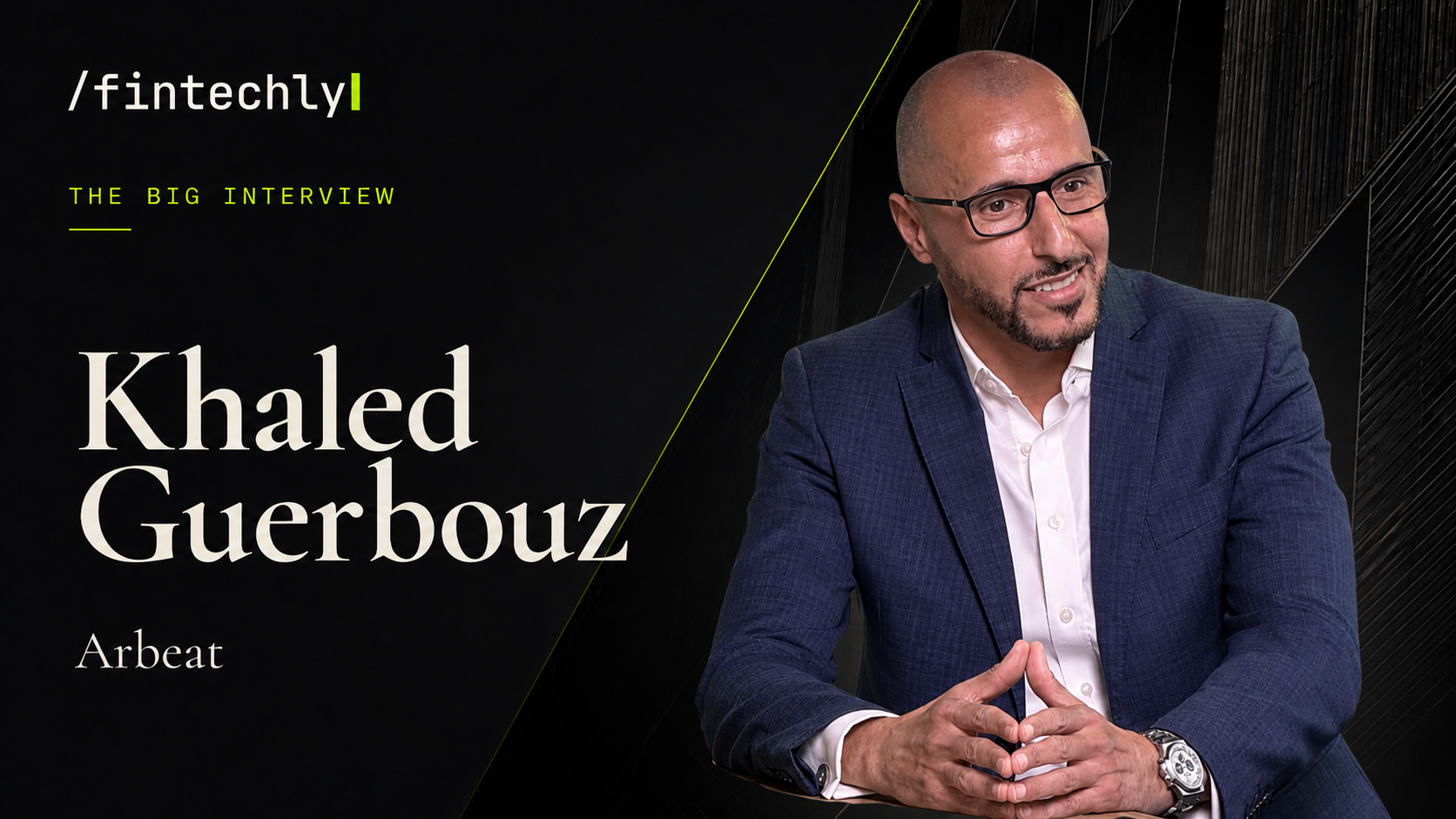
- Who
- Khaled Guerbouz, Group CEO, Arbeat (Dubai)
- Background
- 25 years in finance and markets, including 17 years in FX brokerage in the GCC
- The venture
- Institution-first digital-asset infrastructure, spanning an exchange, an OTC broker-dealer, digital payments, and real-world-asset tokenisation
- Status
- Has received VARA In-Principle Approval and is progressing through the final stages of the licensing process
- Backing
- Self-funded and well capitalised, deploying its own capital in stages; not raising externally
- The bet
- Crypto's missing piece isn't another exchange. It's the regulated infrastructure to issue, trade, settle and pay for tokenised assets in one place
KEY TAKEAWAYS
- 01 Arbeat is building four connected layers (exchange, OTC broker-dealer, payments and real-world-asset tokenisation) under one VARA framework, aimed at institutions rather than retail.
- 02 Its central argument is that tokenised real-world assets still lack a liquid secondary market, the gap Arbeat intends to fill, though its liquidity model is undisclosed.
- 03 Arbeat holds VARA in-principle approval but is not yet trading, is self-funded and not raising, and enters a Dubai market already served by OKX, Binance, Kraken and Deribit.
Institutional capital has circled digital assets for a decade and mostly stayed on the sidelines. The obstacle, Khaled Guerbouz argues, was never the assets. It was everything wrapped around them: the exchange to trade on, the desk to convert fiat, the payment rails to move money, and the settlement and custody a compliance team can stand behind. Those functions exist, but they sit with separate providers never designed to work together, and few fall under a single regulator.
Arbeat, the Dubai venture Guerbouz leads as Group CEO, is a bet that whoever assembles those pieces into one regulated venue takes the institutional market. It is built around four connected layers: a virtual-asset exchange, an OTC broker-dealer, digital payments, and real-world-asset tokenisation, all designed to run under one VARA framework. Institutional capital is ready to be deployed, Guerbouz says, where the right infrastructure exists.
Guerbouz spent 25 years in finance and markets, including 17 years in FX brokerage in the GCC, before turning to digital assets. His read is that the market has spent a decade perfecting the wrong half of the problem. Retail platforms made it effortless to buy a coin. Institutions, he argues, never struggled with that part.
What institutions actually struggle with
“Institutions don’t struggle with buying bitcoins. They struggle with everything that comes around it.”
“Institutions don’t struggle with buying stablecoins or bitcoins,” Guerbouz says. “What they struggle with is everything that comes around it: governance, regulated counterparties, proper segregation of assets, reporting, compliance, onboarding, reliable execution. And all that has to fall under a regulatory framework.”
This is the familiar complaint of any fund that has tried to allocate into digital assets. The tools exist, but they are scattered across providers never designed to work together, and few carry the operational guarantees a compliance team can stand behind. Guerbouz’s claim is that the technology was never the obstacle. “There are a lot of tech guys out there telling you, here it is, we can build you a platform. What institutions need is someone who understands the operational requirements, not just the tech.”
If he is right, the moat in institutional crypto is not the code but the regulated operational layer around it. It is a view shaped by his background in regulated brokerage rather than software, and it matches how slowly institutional money has moved into digital assets so far.
One roof, not four
Arbeat’s answer is to put the pieces institutions need into one regulated venue rather than four. Guerbouz describes four connected layers: a virtual-asset exchange; an OTC broker-dealer arm for stablecoin and fiat conversion; digital payment rails for AED and USD on- and off-ramps; and tokenisation, the issuance and distribution of real-world assets on-chain.
“We want institutions to feel they’re dealing with financial market infrastructure, not just another crypto platform.”
His case for combining them is operational. “Today digital interactions are fractionalised,” he says. “You use an exchange to trade, a broker-dealer to convert fiat to crypto, another company to tokenise. That creates more counterparties, more complexity.” His analogy is a supermarket: institutions would rather buy everything under one roof than visit the vegetable shop, then the dairy shop, then somewhere else.
That logic rests on one assumption that remains unproven: that bundling these functions produces materially safer or faster execution at institutional scale, rather than simply one vendor in place of four. No operator has yet demonstrated it. Guerbouz frames the prize as interoperability: an asset issued, traded, settled and paid for inside a single system, easier to audit because it all happens in one place.
The liquidity problem nobody has solved
Where the argument turns concrete is tokenisation. Real estate, securities and precious-metal commodities are already being issued on-chain across Dubai’s regulatory regimes, but the market to trade them afterwards barely exists. “There’s no secondary-market infrastructure that allows round-the-clock trading. Those mechanics are not applied yet,” Guerbouz says. He is careful not to oversell it. A tokenised bar of gold can be bought today, he says, but not sold around the clock, “because that implies a particular design, a liquidity pool to be created and governed, different stakeholders brought together.”
“Those assets are being tokenised. There’s no secondary market that allows round-the-clock trading.”
That, in his telling, is the real work left, and it is less a technology problem than a coordination one. “It comes down to bringing the regulator, asset owners, liquidity providers, market makers and stablecoin issuers together to fill the few gaps left.” He says Arbeat has designed a model to address secondary-market liquidity that it will deploy once operational, but declined to detail it. The model that underpins the claim is therefore one no one outside the company has seen.
He points to a second gap above his own company’s: standardisation. With assets tokenised across different blockchains, backed by different stablecoins and built to different specifications, he expects regulators to start imposing common standards. “From the moment you regulate an activity like tokenisation, you want to standardise the market. I think we’ll see regulators going that way.”
The regulatory bet
Arbeat has built specifically for Dubai’s Virtual Assets Regulatory Authority, the emirate’s dedicated digital-asset regulator, rather than the financial free zones of the DIFC or Abu Dhabi’s ADGM, which run their own broad financial regulators. The reasoning is that a specialist regulator suits a specialist business. “VARA is a dedicated digital-asset regulator. All the activities we want to cover fall under it. I don’t think there is any other regulator in the world with that level of specificity.”
He describes the relationship in warmer terms than most licensees would. “We see the regulator as a supervisory partner, rather than police on top of our head.”
“We’re not a typical startup chasing funding every quarter to survive.”
None of it is live yet. Arbeat holds in-principle approval, VARA’s signal that it is comfortable with the business model and governance, and says it has completed technology, security and operational-readiness testing while it awaits final review. “We’re ready, we’ve been tested across the board. We’re just waiting for the final feedback from the regulator.” Unusually for a startup in a capital-hungry sector, Guerbouz says it is not raising. “We’re well capitalised and well funded, with a plan to deploy our capital in stages. We’re not a typical startup chasing funding every quarter to survive.” Its shareholders, he said, own a range of other businesses and bring relationships and operational support; he did not name them. It is also entering a Dubai market where licensed, well-capitalised incumbents such as OKX, Binance, Kraken and Deribit already trade.
Asked what success looks like by the end of 2027, Guerbouz first jokes, “unicorn”, then lands somewhere slower. “We’re here for the long term. We want to build confidence in the market, build a brand and an infrastructure under the most credible regulator,” and, eventually, “to empower the digital economy of the country” and play a role beyond it.