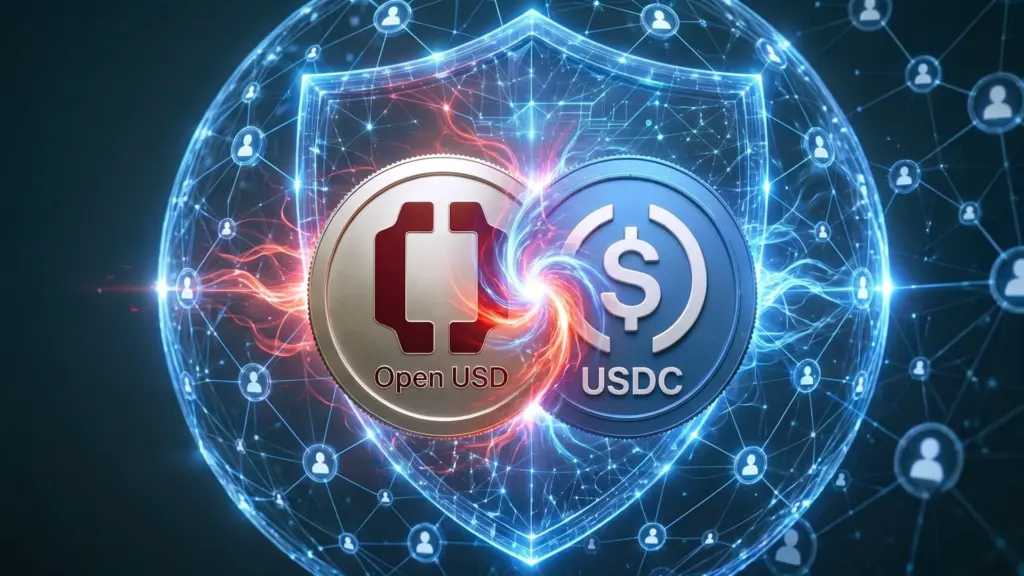
The Open USD stablecoin, announced on 30 June 2026 and backed by more than 140 payments and fintech companies, is the first serious attempt to run stablecoin infrastructure as a shared utility rather than a private asset.
Visa, Mastercard, American Express, Stripe, Coinbase and BlackRock rarely put their names on the same launch, and here they sit alongside banks including BNY, Standard Chartered, Singapore’s DBS and U.S. Bank, and platforms including Google, Shopify and Adyen. But the logos are the least interesting part. What Open USD actually changes is who earns the money a stablecoin throws off, and who sets the rules.
A consortium, not another coin
Open USD is run by a separate company, Open Standard, whose board is made up of its partner businesses rather than a single issuer. Zach Abrams, who co-founded the stablecoin firm Bridge that Stripe bought for about $1.1bn, is interim chief executive.
The economics are where it breaks from the market. Businesses can mint and redeem the token with no fees and no volume caps, and the income earned on the reserves backing it is returned to the partners minus a management fee, rather than kept by the issuer. Tether and Circle between them hold more than 80% of a roughly $320bn stablecoin market, and both keep the reserve income for themselves. Open USD is proposing to hand most of that back to the firms driving the volume.
The token is designed to be blockchain agnostic, launching across Base, Ethereum, Solana and Tempo later in 2026. It is an announced consortium, not yet a circulating coin: USDC and USDT are live today with hundreds of billions in issue. The roster is cross-border too: alongside the US names sit Latin America’s Mercado Pago and the remittance firm Remitly, the spread a dollar rail needs to clear payments between jurisdictions.
Why 140 companies showed up: the reserve yield
The reserve yield explains why the biggest names in payments queued up for a token that doesn’t exist yet.
Circle earned $2.64bn in reserve income in 2025, the interest on the Treasuries and cash sitting behind USDC. That float reached $75.3bn by year end, with the reserves earning an average yield of 4.26% as of mid-2025. Users hold a dollar that pays them nothing; the issuer keeps the interest. That single number explains the guest list: Open USD is offering to split a pot on that scale across its partners rather than let one issuer bank it. Nobody shares revenue on a small market.
Radi El Haj, chief executive of the payments processor RS2, is blunt about what’s pulling them in. “Reserve yield is the actual business model behind most stablecoins,” he says. “It’s how issuers make money while promising users a free dollar. Splitting that yield across 140 partners only works if volume is enormous, which tells you these companies think this is going to get very big, very fast.”
The incumbent model is also more fragile than it looks. Circle’s reserve income rides on interest rates as much as on volume: it reported a 68 basis point fall in its reserve return rate in the fourth quarter of 2025, and estimated that a 100 basis point move in yields would swing reserve income by around $618m a year.
A token whose economics rests heavily on one issuer’s rate exposure is a thinner moat than its market share suggests; spreading both the upside and the risk across 140 balance sheets is part of what Open USD is selling.
The GENIUS Act gave them a floor to build on
The timing is not an accident. The GENIUS Act, signed into US law on 18 July 2025, set the first federal framework for payment stablecoins. It requires full backing in cash and short-dated Treasuries, and monthly public disclosure of what sits in the reserves. For payments giants, a regulated floor turns a stablecoin from a crypto product into a settlement asset a bank compliance team can sign off.
It also changes who wants to own the rails. Once the asset is regulated, the incumbents would rather build shared infrastructure they each hold a piece of than let a single crypto-native issuer own the pipe. “The biggest names in payments are racing to make sure that floor has infrastructure they actually control a piece of,” El Haj says, “rather than infrastructure owned by a single player.”
SWIFT for stablecoins, and SWIFT’s politics
The closest precedent is not another token. It is SWIFT, the cooperative that banks built because none of them wanted correspondent banking run by a rival. “Nobody wanted correspondent banking run by one bank, so they built a cooperative instead,” El Haj says. “Open USD is the same instinct.”
That framing is more useful than the challenger-to-Circle story the market reached for first. Circle’s shares fell around 8% on the news, and Tether’s chief executive greeted it with “Player 2 has entered the game.” Read as a coin fight, Open USD is one more USD token in a crowded field. Read as shared infrastructure, it is a different category.
It also starts a long way behind. Tether’s USDT alone has around $187.9bn in circulation and Circle’s USDC about $75.9bn, per DefiLlama, both already wired into exchanges, wallets and settlement flows worldwide. A consortium token announced in mid-2026 has to win that integration back, partner by partner, before the reserve pool it is promising becomes real.
The harder question is whether cooperative governance survives contact with real money. The strain comes later, over fee splits, reserve-yield shares, and who gets settlement priority when volume spikes. El Haj puts it sharply: “Cooperative infrastructure tends to work brilliantly at launch and get political the moment there is real money on the table.” A board of 140 competitors agreeing on a token is one thing. The same board dividing a multi-billion-dollar reserve pool, across jurisdictions and in a downturn, is another.
The real prize is the orchestration layer
If stablecoins become shared, regulated infrastructure rather than competing products, the winning position is not owning a coin; it is routing across all of them. No merchant wants to bet its business on a single stablecoin surviving, and no processor wants to hard-code one token into its rails. That is the same problem card networks already solved: routing in real time across whichever rail actually clears.
“For processors, the opportunity is not picking Open USD’s winner,” El Haj says. “It is building the orchestration layer that does not have to.” Whichever dollar token clears cheapest and fastest for a given corridor, the layer that routes to it captures the value regardless of which logo wins. Fintechly has tracked Visa and Mastercard pushing multi-rail settlement into agentic commerce, and the logic is the same here: the value moves up a level, from the asset to the switch that decides where a payment goes.
That is the durable question for the builders, funders and regulators watching Open USD. Europe’s euro stablecoin projects and the dollar consortiums will multiply, and most will not be the one that wins. What matters is who controls the money-movement layer that routes across them, cross-border and across every rail.
Citi’s base case still puts the stablecoin market at $1.9tn by 2030, with an upside near $4tn, room enough for several large tokens. The land grab for a single winning coin was always the wrong game; the utility, and the orchestration on top of it, is where this decade of payments gets decided.