
Global payments company Visa has launched its global Agent Readiness program in the UAE as part of its broader regional expansion across Central and Eastern Europe, the Middle East, and Africa.
The initiative is designed to help financial institutions prepare for the next evolution of digital commerce, where artificial intelligence agents can assist consumers in discovering products, making purchasing decisions, and completing transactions on their behalf.
The program reflects growing momentum around AI-powered commerce solutions as digital payments increasingly move toward automated, intelligent, and personalised consumer experiences.
In the UAE, the launch further strengthens the country’s position as one of the region’s leading innovation hubs for digital payments and AI-enabled financial services.
What Is Visa’s Agent Readiness Program?
Visa’s new initiative focuses on preparing banks, fintech companies, and payment providers for a future in which AI agents are more deeply integrated into everyday commerce.
The first phase of the program allows issuers to test transactions initiated by AI agents within a controlled environment that closely mirrors real-world production systems.
This approach enables financial institutions to evaluate how AI-driven payment flows could function at scale while maintaining compliance, security, and operational reliability.
Core Objectives of the Program
| Focus Area | Purpose |
| AI-powered commerce testing | Evaluate AI agent-initiated payment transactions |
| Controlled operating environment | Simulate real-world payment infrastructure safely |
| Issuer readiness | Prepare financial institutions for future AI commerce adoption |
| Consumer trust and security | Maintain payment reliability and fraud protection |
| Digital commerce innovation | Enable next-generation transaction experiences |
The initiative is designed to help financial institutions gradually adapt to emerging AI-driven commerce models before broader market adoption accelerates.
Also, read Lianlian Secures DFSA License to Expand Cross-Border Payments from DIFC
Why AI Agents Could Change Digital Commerce
AI agents are increasingly being viewed as the next major shift in online commerce.
Rather than consumers manually completing every stage of a purchase journey, AI-powered systems could eventually assist with:
Potential AI Commerce Functions
- Searching for products based on user preferences
- Comparing pricing and payment options automatically
- Recommending personalised purchasing decisions
- Completing transactions securely on behalf of users
- Managing recurring payments and subscriptions
This transition could significantly change how consumers interact with digital marketplaces and payment systems.
Growing Interest in AI Commerce Across the UAE
Visa’s launch comes at a time when businesses in the UAE are showing increasing interest in AI-enabled commerce solutions.
According to recent research conducted by Fast Company Middle East in partnership with Visa, nearly 60% of companies in the UAE reported strong interest in or active exploration of AI-powered commerce applications.
The research also revealed that businesses are increasingly viewing AI commerce as a long-term growth opportunity rather than solely a cost-efficiency tool.
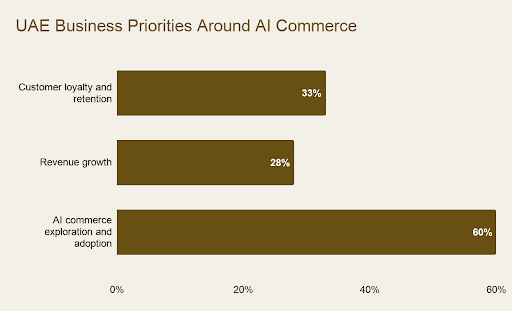
Alt txt: UAE Business Priorities Around AI Commerce and Companies’ Responses
The findings indicate that companies are focusing on AI’s ability to improve customer engagement, personalise commerce experiences, and drive new revenue opportunities.
Why the UAE Is Becoming a Testing Ground for AI Commerce
The UAE’s digital economy strategy has created favourable conditions for emerging payment technologies and AI-led financial innovation.
Several factors continue to position the country as a strong environment for AI commerce experimentation:
Key Market Advantages
- Advanced digital payment infrastructure
- High smartphone and internet penetration
- Government-led AI and innovation strategies
- Supportive fintech regulatory frameworks
- Strong adoption of cashless payment systems
These conditions make the UAE an attractive market for global payment companies introducing next-generation financial technologies.
What This Means for the Financial Sector
Visa’s Agent Readiness program highlights how the financial industry is preparing for a future where AI becomes increasingly embedded into commerce and payments.
AI Could Reshape Consumer Payment Behaviour
As AI agents become more capable, consumers may increasingly rely on automated systems to manage purchasing decisions and payment execution.
This could lead to more seamless and personalised digital commerce experiences.
Financial Institutions Will Need New Infrastructure
Banks and payment providers may need to adapt their systems to support AI-initiated transactions securely and efficiently.
This includes authentication, fraud monitoring, compliance management, and transaction oversight.
Trust and Security Will Become Even More Important
As AI systems gain greater access to financial transactions, maintaining consumer trust will be critical.
Financial institutions will likely prioritise safeguards, transparency, and payment controls to ensure responsible adoption.
Fintech Innovation in the UAE Could Accelerate Further
The UAE’s willingness to embrace emerging technologies could encourage more AI-driven payment and commerce initiatives across the region.
This may strengthen the country’s position as a leading global fintech innovation hub.
Way Ahead
Visa’s launch of the Agent Readiness program signals that AI-powered commerce is moving closer to practical implementation.
While AI-assisted shopping and payment experiences are still developing, the financial industry is increasingly preparing for a future where intelligent digital agents could become active participants in commercial transactions.
The UAE’s inclusion in the program reflects the country’s growing importance in shaping next-generation financial technology trends.
As banks, fintech companies, and payment providers continue experimenting with AI-led commerce models, initiatives like this could play a key role in defining how digital payments evolve over the coming years.