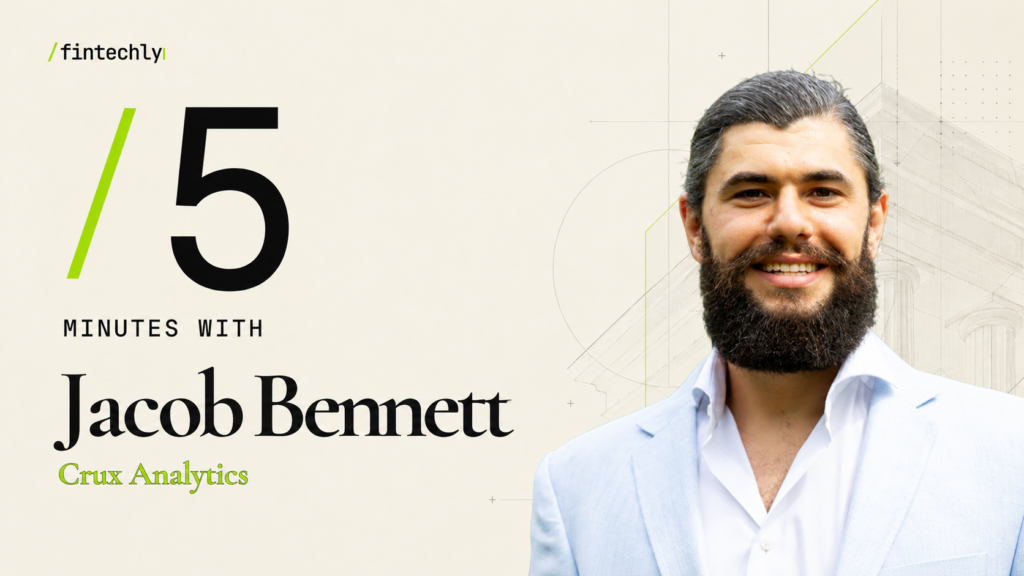
Welcome to Fintechly’s Five Minutes With… — where we chat to fintech founders, leaders and operators about what they’re building, what they’re watching, and where the industry is heading.
Today, we speak to Jacob Bennett, CEO and co-founder of small business banking platform Crux Analytics.
Crux Analytics builds technology for small business banking, helping banks and credit unions strengthen relationship-led engagement with business customers at scale.
Jacob, can you tell us about yourself and what brought you to this point in your career?
I was born and raised in London, and from a very young age, I was the kind of kid who needed to understand how things worked. Legos, a makeshift workshop at home, I was always pulling things apart. I was never a great fit for traditional education, probably because I got distracted too easily, but I always gravitated towards subjects that helped me make sense of the world.
That instinct followed me into my career. I have always thrived in what people now call the zero-to-one phase, staring at a blank page and turning it into something valuable. I started two companies before Crux. The first was an early attempt at a venture studio working with hardware founders. The second was a boutique innovation consultancy, where my co-founders and I worked across industries with companies of all sizes, from early-stage product development through to large-scale experiential projects. We touched a lot of different sectors, which suited me well, because I have always been most comfortable shifting context every few months.
Growing that business is what brought me to Crux. I experienced firsthand all the challenges smaller business owners face, but one thing that never made sense to me was how unproductive our banking relationship was. We had a relationship manager who would ring once a quarter, and it felt like a chore for everyone involved. They were not a strategic partner to us, and yet they absolutely could have been. That gap, between what the relationship was and what it should have been, planted the seed for everything that followed.
What problem or opportunity are you most focused on right now?
What we have come to understand, really clearly over the last couple of years, is what I would call the scaling paradox facing any institution that sells to small businesses. The small business economy is growing, the market opportunity is significant, and a lot of institutions are actively trying to grow their business customer base. But at the same time, that market demands a deeply relationship-driven approach. You cannot just automate your way through it.
So the question we are solving for is this: how do you achieve real scale while still delivering a genuinely relationship-first experience to every business owner you serve? Adding to headcount indefinitely is not a viable answer, and yet the relationship cannot be stripped out. Finding that balance, and building the technology and processes that unlock it, is where all of our focus sits right now.
What do you think deserves more attention than it is getting in your part of the industry?
I think it is the role of human capital. If you look at recent quarterly reports and CEO letters from across the banking industry, there is a lot of conversation about AI and technology investment. What tends to get less attention is the fact that many of those same institutions are also investing heavily in people, in the relationship managers who sit across the table from business owners and have real conversations. The major banks of the world are among the few institutions that can genuinely scale through headcount, and they are doing exactly that, in parallel with their technology investment.
The question that does not get asked enough is where you find the right balance and how you leverage human capital to its greatest potential. That is actually core to our thesis at Crux, and I think it is a much more nuanced and interesting conversation than simply asking how much an institution is spending on AI.
What do you think people still misunderstand about your part of the industry?
The fear that AI is going to replace jobs in banking is still very present, and understandably so. But I think the more accurate framing, which we are starting to hear from some institutions directly, is that AI is not taking existing roles today. What it may do over time is reduce the future headcount that was initially planned for but may not ultimately be needed. It is optimising the future rather than dismantling the present.
Our core belief at Crux is that the technology we are building is designed to amplify human relationships, not replace them. The human element is absolutely essential in what our bank and credit union customers do with their business customers. When you are talking about a relationship that is fundamentally built on trust and conversation, the idea that a machine simply takes over misses the point entirely. In some industries and some contexts, displacement will happen. But in relationship banking, that conversation is misplaced.
What do you expect to rise up the agenda over the next year?
For our customers, the conversation has already started to shift. The first wave of AI deployment in financial services was focused on back-office efficiency, automating processes, and reducing operational overhead. What we are seeing now is a clear move towards front-office revenue generation, towards using these tools to actually drive growth. That shift will only accelerate.
For smaller banks and credit unions in particular, which are navigating increased competitive pressure from neobanks and the large nationals at the same time as they face growing market demand, the central question is going to be how they achieve real revenue growth and not just efficiency gains. Technology has to earn its place on the income statement, not just the cost base.
From our own perspective, something that has risen up the agenda very recently is the organic market opportunity sitting outside our core banking focus. There are verticals adjacent to that core relationship that are increasingly coming to us, and we are starting to pursue those more aggressively.
Bonus: What is the one question you should have been asked, and what is your answer?
Probably the question nobody asks directly, which is where are you actually trying to take this company? What does Crux look like in five or 10 years?
There are two ways I would answer that. The philosophical version is that our goal is to be the relationship layer connecting key service providers to the small businesses they serve. We started with financial institutions, but we are already beginning to think beyond that, about how Crux becomes the connective tissue between institutions that share the same customers and could be doing so much more together.
The benchmark I keep coming back to is Bloomberg. What Bloomberg is to public markets, we want Crux to be to the small business economy, the indispensable infrastructure that every key player in that world runs on.