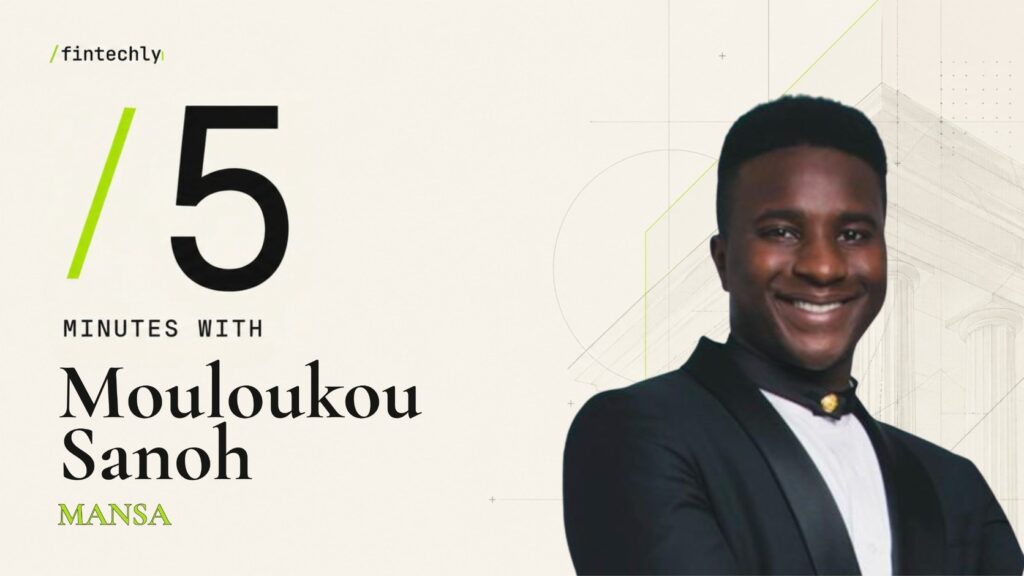
Welcome to Fintechly’s Five Minutes With… — where we chat to fintech founders, leaders and operators about what they’re building, what they’re watching, and where the industry is heading.
Today, we speak to Mouloukou Sanoh, co-founder and CEO of MANSA, a payments infrastructure fintech focused on liquidity for cross-border settlement.
MANSA provides stablecoin-based settlement infrastructure for payment operators, helping them move money across high-volume corridors without locking up capital in each destination market.
Mouloukou, can you tell us about yourself and what brought you to this point in your career?
While studying in Hong Kong, my parents would send money from overseas to support me, and the experience was brutal. Transfers took days, fees ate into every payment, and there was no transparency about where the money was at any given moment. That frustration stayed with me through everything that followed.
After my studies, I spent years working across investment and technology in emerging markets, including extended periods in private equity and investment banking. I covered China as a TMT research analyst, ran investment at Adaverse, and founded Mansa Capital, an investment advisory focused on African companies.
Each of those experiences brought me closer to the same conclusion: the infrastructure moving money across borders into emerging markets was fundamentally broken. MANSA was the inevitable next step, building the settlement layer that operators actually need.
What problem or opportunity are you most focused on right now?
Prefunding. It is the single biggest barrier to scaling cross-border payments into emerging markets, and most people outside the industry have never heard of it. Payment operators are required to hold capital in every destination corridor before they can process a single transaction. That means tying up millions in idle reserves across Nigeria, Ghana, the Philippines, and wherever else they want to operate. For smaller operators, it locks them out entirely. For larger ones, it is a massive drag on capital efficiency.
MANSA exists to eliminate that requirement. We operate as a settlement layer powered by stablecoin infrastructure, providing just-in-time settlement so operators can move money in real time, 24/7, without parking capital in every corridor.
In 18 months we have processed almost $400 million across seven corridors with 46% month-on-month growth. The opportunity is enormous because the problem is so deeply embedded in how cross-border payments have always worked.
What do you think deserves more attention than it is getting in your part of the industry?
Local currency settlement infrastructure. The industry conversation is dominated by USD-denominated rails and high-profile corridors between developed markets. Meanwhile, the real bottleneck sits at the last mile: getting money converted and delivered in local currencies across African and Latin American corridors where banking infrastructure is expensive or incomplete.
On-ramps, off-ramps, and deep local liquidity in these corridors are what determine whether a payment actually reaches someone on the other end. You can build the most elegant global settlement architecture in the world, but if you cannot reliably convert into naira or cedis at the destination, it does not matter. That infrastructure deserves far more investment and attention than it currently receives.
What do you think people still misunderstand about your part of the industry?
That stablecoin infrastructure is speculative, or that it is a consumer product. When people hear ‘stablecoins’ they often think of retail crypto trading or volatile digital assets. The reality is far less exciting and far more useful. Stablecoins are the rails that allow operators to settle cross-border payments in real time at a fraction of the cost of traditional banking infrastructure. MANSA has processed nearly $400 million using this infrastructure, and the end users receiving those payments have no idea stablecoins are involved. Nor should they.
The misunderstanding matters because it shapes regulation and investment decisions. When policymakers treat stablecoin infrastructure as if it is the same as speculative crypto markets, they risk restricting technology that is already solving real operational problems for payment companies serving some of the world’s most underserved corridors. The companies using our settlement layer are licensed PSPs and EMIs. They are not speculators. They are operators trying to move money faster and cheaper for their customers.
What do you expect to rise up the agenda over the next year?
The shift from legacy rails to infrastructure that actually works for emerging market corridors. For too long, the conversation has been dominated by what is possible between London and New York, or Singapore and Sydney. The real infrastructure challenge is in the corridors where settlement is slowest, most expensive, and most unpredictable: West Africa, Southeast Asia, Latin America.
Operators in these markets are already moving to stablecoin-powered infrastructure because it solves problems that legacy providers cannot or will not address. As that adoption accelerates, I expect regulators and institutional players to follow. The narrative will shift from “should we allow this?” to “how do we ensure it scales safely?” That normalisation will be the defining shift over the next 12 months.
Bonus: What’s the one question about MANSA we should have asked, and what’s your answer?
‘How do you know your operators actually trust the infrastructure?’ Because in payments, trust is something you can actually measure. We surveyed every operator on our platform this year. The results were a 100% recommendation rate, a 9.4 out of 10 average satisfaction score, up to 2x faster processing speeds, and up to 50% faster settlement times. Operators reported revenue growth of over 20% and 5 to 10 hours saved in monthly operational time.
Those numbers matter more than any fundraising headline or volume milestone because they represent what operators experience day to day. If the infrastructure does not make their business measurably better, the volume figures are irrelevant. The fact that every single operator would recommend us tells me we are solving the right problem in the right way.