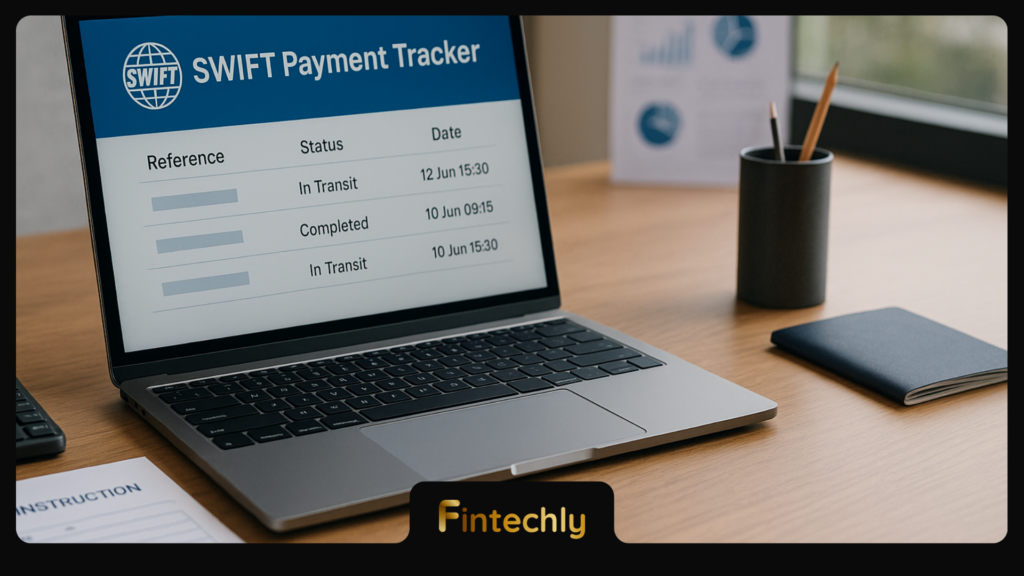
When an international bank transfer seems to vanish between “sent” and “received,” a swift payment tracker is the fastest way to understand where the money is in the chain and what’s needed to release it. In this guide, you’ll learn which “tracker” tools people commonly mean, the identifiers your bank actually needs to trace a payment, and the exact questions to ask when a transfer is delayed.
What people mean by a “SWIFT payment tracker”
SWIFT itself is a secure messaging network used by banks and payment providers to exchange payment instructions. A “tracker” is usually not one universal consumer website. Instead, it’s one (or a combination) of the following:
- Your bank’s online status page: A front-end view that shows internal milestones (created, released, sent, processing, credited, rejected).
- SWIFT gpi tracking (bank-to-bank): A capability participating banks use to follow the payment across correspondent banks with timestamps and status updates.
- Correspondent bank investigations: A manual trace raised by your bank through SWIFT messages when automated status data is unavailable or insufficient.
- Beneficiary bank confirmation: The receiving bank checks whether funds arrived, are on hold, or were returned.
- Independent public trackers: Standalone web tools, separate from any bank, that surface the status data banks make public. An independent SWIFT tracker such as uetr.ai takes the UETR and shows which banks have reported the payment so far, with no banking login needed
For context on how money actually moves between banks, it helps to understand the broader payments and money movement ecosystem—most delays happen in the “in-between” steps where different institutions validate details, screen for compliance, and reconcile accounts.
SWIFT gpi vs. a manual trace: what’s the difference?
SWIFT gpi tracking (the modern “end-to-end” view)
SWIFT gpi (Global Payments Innovation) enables participating banks to see richer tracking data—think of it as bank-grade shipment tracking for transfers. It can show when the payment was received by each bank in the chain, whether fees were taken, and whether the payment is pending, completed, or stopped.
If your bank supports gpi, the most powerful identifier is usually the UETR (Unique End-to-end Transaction Reference). SWIFT provides an overview of the service on the SWIFT gpi solution page.
Manual trace / payment investigation (the fallback when tracking is limited)
When gpi data isn’t available (or a particular correspondent bank doesn’t provide updates), your bank may raise an investigation through SWIFT messages and request confirmation from intermediaries and the beneficiary bank. This process can take longer because it often depends on human handling, reconciliation checks, and formal response cycles between institutions.
What information you need to track a SWIFT payment
To get meaningful progress, you need identifiers that tie your request to the exact payment message and route. Gather as many of the following as you can before contacting your bank.
1) UETR (Unique End-to-end Transaction Reference)
The UETR is a globally unique reference (typically a long alphanumeric string in UUID format) assigned to many SWIFT cross-border payments. If gpi tracking exists, the UETR is often the fastest key to pull a full status trail.
What to ask for: “Please provide the UETR for this payment and share the latest gpi tracking status and timestamps.”
2) SWIFT message reference and/or MT103 copy (or payment confirmation)
For many customer credit transfers, the key document is an MT103 (or its ISO 20022 equivalent, depending on your bank). Some banks can provide a “copy of MT103” or a payment confirmation that includes crucial fields. Even if you don’t understand every line, your bank’s investigations team will.
What to ask for: “Can you share the payment message reference and a copy of the MT103 (or equivalent) showing beneficiary details and all references?”
3) Sender and beneficiary details (exactly as instructed)
Mismatches are a common cause of holds and “repairs.” Have these ready:
- Ordering customer (sender): name and account number
- Beneficiary: name and account number/IBAN
- Beneficiary bank: name and BIC/SWIFT code
- Intermediary/correspondent bank details (if provided): BIC and routing instructions
4) Amount, currency, and value date
Always include the exact amount and currency sent, plus the value date (the date the payment is intended to settle). If the beneficiary reports receiving a smaller amount, ask whether fees were taken “SHA/OUR/BEN” (shared, sender pays, or beneficiary pays) and at which point.
5) End-to-end payment reference (your internal reference)
Your bank may also use an internal transfer ID, transaction receipt number, or “end-to-end ID.” This can be helpful for the bank’s internal workflow even if it’s not visible to other institutions.
Why SWIFT payments get “stuck” (and what the status usually means)
Cross-border payments pass through multiple checks. Here are the most common delay points:
- Compliance screening (AML/sanctions): A name or country match triggers review. Screening doesn’t mean wrongdoing; it often means the bank needs clarification.
- Missing or inconsistent beneficiary info: wrong IBAN/account, name mismatch, or incomplete address details can trigger “repair” workflows.
- Intermediary bank routing issues: funds may be routed through correspondents that require additional data or have cut-off times.
- Bank cut-off times and holidays: even “sent” payments may not be processed until the next business day in one of the involved countries.
- Operational holds and investigations: banks may pause processing if they receive contradictory instructions or need confirmation.
- Returned payments: the beneficiary bank can reject funds (closed account, invalid details, regulatory reason), after which a return is initiated.
If a delay involves screening, it can help to understand how financial institutions reduce risk across the transaction lifecycle. See financial crime prevention in fintech for a broader view of why banks sometimes pause payments to validate parties and purpose.
For an official perspective on sanctions and why banks may hold or reject transfers during screening, review OFAC sanctions programs and country information.
What to ask your bank when a SWIFT payment is delayed
When you contact your bank (chat, branch, or phone), be specific and ask for actionable data—not just “it’s processing.” The goal is to determine: (1) where the payment is, (2) who currently has it, and (3) what exact information is needed to move it forward.
Use this script: “Please trace my SWIFT payment and confirm the latest status by UETR (or message reference). Which bank currently holds the payment, what is the reason code or narrative, and what exact details or documents are required to release it or return it?”
Request the route and the current holder
Ask your bank to confirm:
- The full chain of banks involved (sending bank, intermediaries/correspondents, beneficiary bank).
- The timestamped status for each hop (if gpi is available).
- Which institution currently has the payment in a pending or stopped state.
Ask whether the payment is in “repair”
“Repair” typically means the payment can’t be processed straight-through because something is missing or inconsistent. Ask exactly what field is causing the repair (beneficiary name, address, account/IBAN, purpose of payment, intermediary details, etc.).
Ask if the payment is on a compliance hold (and what you can provide)
If the issue is compliance, you may be asked for invoices, contracts, proof of relationship, or an explanation of the payment purpose. Ask whether the hold is at your bank, an intermediary, or the beneficiary bank—and whether there is a way to provide documents through your bank’s secure channel.
Confirm whether a recall, amendment, or cancel request is possible
If details are wrong, your bank might attempt an amendment or recall. Be aware that recalls are not guaranteed; the receiving side may already have credited funds or may require the beneficiary’s consent to return them.
Checklist: the minimum details to provide (copy/paste)
Sending this in one message reduces back-and-forth and speeds up investigation queues.
- UETR: [paste if available]
- SWIFT message reference / transaction ID: [paste]
- Date sent & value date: [dd/mm/yyyy]
- Amount & currency: [e.g., 10,000 USD]
- Sender name & account: [exact]
- Beneficiary name & IBAN/account: [exact]
- Beneficiary bank name & BIC: [exact]
- Intermediary bank (if any): [name/BIC]
- Payment purpose: [one sentence]
- Fee type: [SHA/OUR/BEN if known]
How long should SWIFT tracking take?
Timing depends on corridors, correspondent networks, cut-off times, and checks. As a practical expectation:
- Same day to 2 business days: common for many major corridors when details are correct and straight-through processing works.
- 2 to 5 business days: common when intermediary banks are involved or there are time zone/holiday differences.
- 5+ business days: often indicates a compliance hold, repair queue, rejection/return process, or an investigation awaiting responses.
If you’re seeing persistent delays, it may reflect broader changes in cross-border rails and transparency expectations. The trendline is toward faster, more trackable transfers—see the future of cross-border payment tracking to understand where the industry is headed.
Practical steps if the beneficiary says “nothing has arrived”
It’s possible for a payment to be “at” the beneficiary bank but not credited (for example, awaiting internal review). Use this process:
- Step 1: Ask your bank for the UETR and the latest gpi status (or trace results). Identify the last bank that acknowledged receipt.
- Step 2: Share the UETR or payment reference with the beneficiary (and beneficiary bank) if they request it, but avoid oversharing sensitive personal data.
- Step 3: Ask the beneficiary to confirm whether the payment is on hold (compliance/repair) rather than “not received.”
- Step 4: If details are incorrect, decide quickly whether to attempt an amendment or recall.
Common mistakes that prevent accurate SWIFT payment tracking
- Only providing a screenshot: bank staff usually need references like UETR/message reference, not just a “sent” status.
- Using approximate beneficiary names: even small differences can trigger repairs and compliance checks.
- Confusing IBAN, account number, and routing: ensure you used the correct format for the destination country.
- Not asking who currently holds the payment: “processing” without a holder doesn’t tell you where the delay sits.
- Waiting too long to escalate: if a payment is truly misrouted or rejected, early investigation can reduce resolution time.
FAQs
Can I track a SWIFT payment myself online?
Usually not in a universal public tool. Tracking is typically available through your bank’s portal, your bank’s support team, or bank-to-bank tools like gpi. The most effective approach is to request the UETR or MT103 details and have your bank trace the payment.
Is an MT103 the same as a SWIFT payment tracker?
No. An MT103 (or equivalent) is a message/payment confirmation that contains structured details and references. A “tracker” is the status view or investigation process that uses those references (plus gpi data, if available) to identify where the payment is.
What’s the single most important identifier to request?
If your bank supports gpi tracking for that payment, request the UETR. If not, request the SWIFT message reference and a copy of the payment confirmation (often an MT103) so the investigations team can trace it through correspondents.
What should I do if the payment is stuck due to compliance checks?
Ask which bank is holding it and what exact documents they need. Provide clear proof of payment purpose (invoice/contract), relationship to the beneficiary, and any additional information your bank requests. If sanctions screening is involved, resolution can take longer and may not be overrideable.
Can a SWIFT payment be recalled or cancelled?
Sometimes. Your bank can submit a recall or cancellation request, but success depends on where the payment is and whether the receiving bank (and beneficiary) agree. If the beneficiary bank has already credited funds, the process may require beneficiary consent.
Key takeaway
A “SWIFT payment tracker” is really a set of tracking and investigation capabilities. To get fast answers, lead with the right identifiers—especially the UETR and/or MT103 details—and ask your bank who currently holds the payment, why it’s pending, and what exact information will release it.