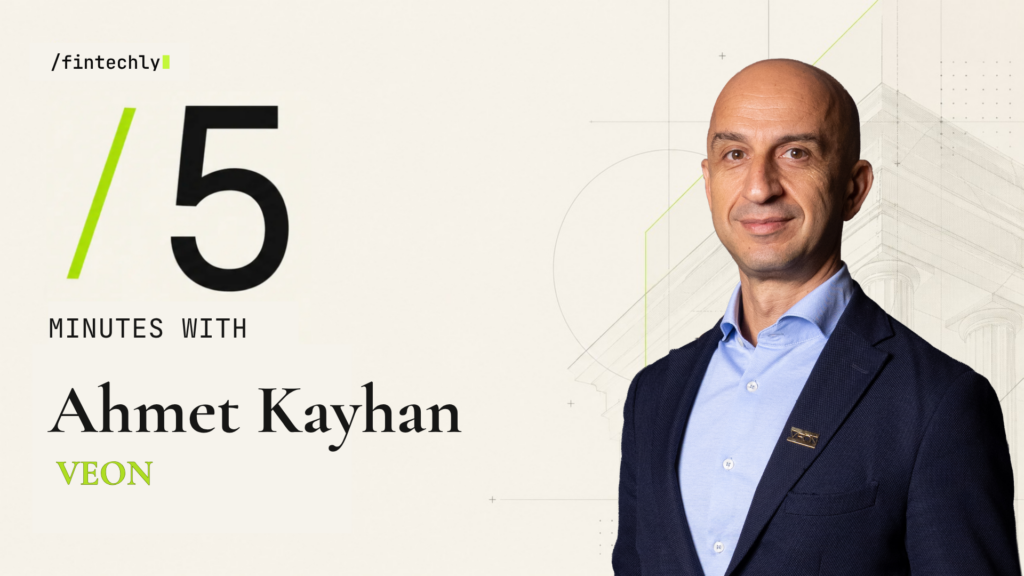
Ahmet Kayhan joined VEON, the Dubai-headquartered, Nasdaq-listed telecoms and fintech group, as Chief Payments & Digital Assets Officer in April 2026, after roles at DgPays Group and on NEOPAY’s board. VEON’s fintech business now spans JazzCash in Pakistan, plus operations in Kazakhstan and Uzbekistan, with a fourth market, Bangladesh, preparing to launch through Banglalink’s Mukto Pay. Group financial services revenue hit $151 million in the second quarter of 2026, up 48.5% year on year. We asked Kayhan what’s actually behind that growth, what “Digital Assets” means in a title that neither VEON‘s appointment release nor its full 2Q26 investor deck defines, and what’s shaping the Bangladesh launch.
Congratulations on the new role, it’s been about five months now. I’d love to understand the ‘Digital Assets’ side of your title a little better, since it’s not something VEON’s public materials have gone into detail on yet. Is there a workstream already taking shape there, or is that still early days?
It is taking shape, but we are deliberately starting with the problem rather than the technology.
For us, digital assets are a natural extension of the financial infrastructure we already operate at scale.
That means looking at practical areas such as value preservation, wealth management and more efficient remittance rails, particularly in markets where customers face currency volatility or expensive cross-border transfers.
Stablecoins are one of the clearest near-term use cases because they are understandable and can address genuine customer needs.
We are also exploring the wider potential of regulated virtual-asset solutions, including through the memorandum of understanding between JazzCash and Binance.
But any development must align with local regulation, consumer protection and a demonstrable economic need.
If we cannot solve a real problem, there is no reason to deploy the technology.
Group financial services revenue hit $151 million in the second quarter, up 48.5% year on year, now 44% of digital revenue. Strip that down for me, how much of that growth is more customers, how much is existing customers using more products like lending or insurance, and how much is new markets like Uzbekistan scaling up?
All three are contributing.
What it does show is that this is not simply a customer-acquisition story. Our platforms reached 59 million customers, while the behaviour of existing customers also deepened.
At JazzCash, twelve-month transaction volume grew 57.1% year on year and average transactions per user increased 56.3% in the second quarter. Customers are transacting more frequently and using a broader range of services, including payments, lending, insurance and investment products, highlighting the trust these customers have in VEON.
Other businesses across the group are also making meaningful contributions. In Uzbekistan, Beepul surpassed UZS 87 billion in second-quarter revenue, reached more than one million active users and became the country’s fourth-largest payment platform by revenue.
We are also seeing continued momentum in Kazakhstan through Simply and further expansion of our financial services footprint with the launch of Mukto Pay in Bangladesh. So the growth is increasingly diversified, broader customer reach, greater engagement and product depth, and the scaling of platforms beyond JazzCash in Pakistan.
Banglalink is targeting a PSP platform launch in September. You’ve already built payments businesses in Pakistan, Kazakhstan and Uzbekistan. What’s the one lesson from those three markets that’s directly shaping how the Bangladesh launch is being run, and what are you doing differently this time because of it?
The central lesson is that there is no universal template.
The transferable capability is our experience in building trusted, mobile-first financial infrastructure, but the proposition itself must be designed around local customer needs, regulation and market conditions. Our approach is to apply the JazzCash experience selectively rather than reproduce it product for product.
That is why Mukto Pay begins with practical, high-frequency services, money transfers, merchant and e-commerce payments, utility and government bills, salaries and other disbursements.
It is designed for individuals, micro-merchants and small businesses, and it is being launched through Banglalink’s trusted local digital ecosystem following approval from Bangladesh Bank.
What we are doing differently is starting with the specific gaps in Bangladesh’s formal financial system rather than assuming that the market follows the same development path as Pakistan, Kazakhstan or Uzbekistan. Trust, relevance and regulatory alignment come first and, after that, scale.
The Mastercard partnership is framed as scaling AI-enabled financial services across four markets. What does AI concretely change in a lending or fraud decision at VEON’s scale, what’s the actual before-and-after?
Before AI-enabled decisioning, customers with little or no conventional credit history can be difficult to assess.
A traditional financial model may exclude them even when their actual payment, usage and repayment behaviour demonstrates that they could use and repay a small loan responsibly.
AI allows us to analyse relevant behavioural and transactional signals and produce a more individual assessment. The result is a system that is built around the customer and doesn’t rely on a one-size-fits-all decision.
In fraud, the shift is from broad rules that may either miss new patterns or stop legitimate activity to more contextual, real-time risk assessment. That can help identify unusual behaviour earlier while allowing more genuine transactions to proceed without unnecessary friction.
The cooperation with Mastercard is intended to combine VEON’s local platforms, distribution and data-driven capabilities with Mastercard’s payment technology and expertise.
The programme includes AI-powered products, alternative credit scoring, embedded finance and digital wallets, beginning with pilots in Ukraine and Kazakhstan before potential expansion. We have not yet published a quantified before-and-after result from these pilots.
If ‘Digital Assets’ does show up in a future investor presentation, what would it plausibly look like, stablecoin solutions for remittances between these markets, tokenised lending, something else entirely, or is it genuinely too early to say?
It would most plausibly begin with regulated solutions that address an immediate customer problem. Stablecoins are a practical candidate, particularly for value preservation and remittances, where customers can face cost, speed and accessibility challenges.
Cross-border settlement and supplier payments may also become relevant as regulatory frameworks mature.
Tokenisation has genuine potential, but it also carries unresolved questions around issuer risk, trust and the legal connection between a token and ownership of the underlying real-world asset.
Those questions must be settled before tokenisation can become a mainstream proposition.
So it is not too early to identify the direction, but it is too early to promise a particular product or timeline.
Digital assets could turn out to be the next layer of trusted, programmable financial infrastructure.