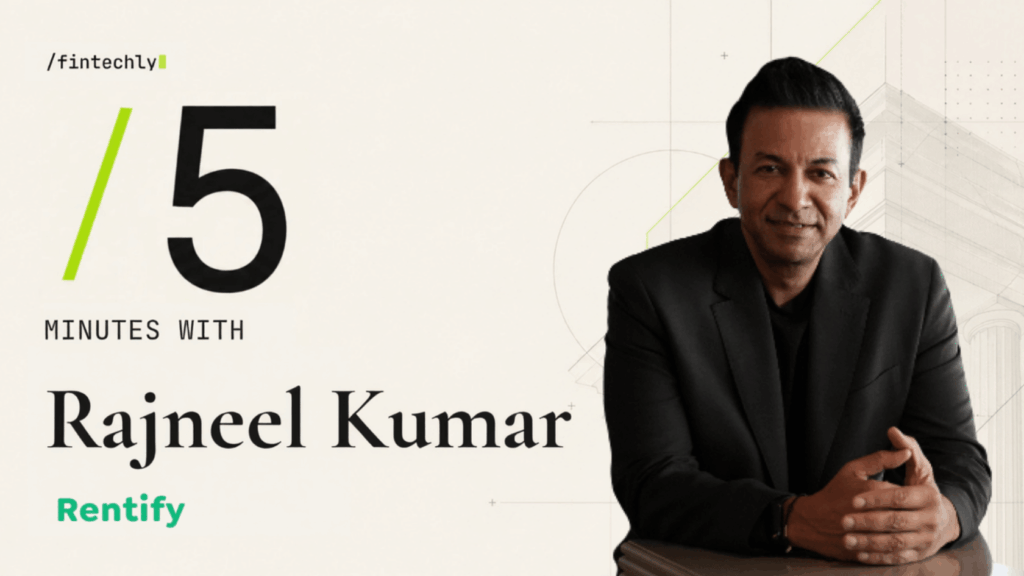
Rentify has built an AI operating layer, Earn AI, that sits on top of property portfolios and handles the operational work of managing them, lease intelligence, rent collection, and now renewals, without the company holding any of the regulated licences underneath the insurance and payments it embeds along the way. We spoke with co-founder Rajneel Kumar about what a $2.5 million, capital-light company is actually exposed to when it wires other people’s regulated products into a single interface, and whether the model travels beyond the UAE.
Before Rentify, you spent close to two decades building consumer platforms, VOOT, Coto, and working across Viacom18 and Genomedia Studios, reaching hundreds of millions of users. None of that was regulated, capital-intensive infrastructure. Now you’re embedding insurance and payments into property management, businesses where licensing, liability and compliance actually matter. What from that consumer-scale background prepared you for taking on that kind of regulatory and financial exposure, and what didn’t translate at all?
What translated was the discipline of building complex products for very large numbers of people without making the complexity visible to the user.
At consumer scale, reliability is not an engineering detail. It is the product. The same principle applies to Rentify, except the consequences are higher because we are now dealing with rent, identity, payments, insurance and financial data.
What did not translate was the ability to optimise purely for speed. In consumer technology you can launch, measure and iterate quickly. In financial infrastructure, you have to build the controls at the same time as the experience.
That has shaped how we built Rentify. We do not try to become the insurer, lender or regulated payment institution ourselves. We build the intelligence and workflow layer and connect it to licensed infrastructure underneath.
The result should still feel like a consumer product, but what sits behind that experience is very different: consent management, audit trails, permissions, regulated partners, payment controls and clear ownership of each part of the transaction.
Rentify has raised $2.5 million total, a seed round from June. Earn AI is described as supporting roughly $6 billion in property assets and more than $350 million in annual rental value. Those two numbers are a long way apart. Help me understand the relationship: is the $6 billion a measure of the portfolios using the platform, not capital Rentify itself deploys or is exposed to? And how does a $2.5 million seed fund the engineering behind three AI agents plus regulated-partner integrations at that claimed scale?
Exactly. The roughly $6 billion figure represents the underlying value of property portfolios supported through the Earn AI ecosystem. It is not capital deployed by Rentify and it is not $6 billion of balance-sheet exposure.
The same portfolios represent more than $350 million of annual rental value. Our job is to sit on top of that operating activity and make it easier to manage.
That distinction is important because Rentify is fundamentally a capital-light software and infrastructure business. The $2.5 million we have raised is funding the technology layer, not the underlying real estate.
We have also deliberately built one shared architecture rather than three separate AI products. Intelligence, Collections and Renewals use the same property data model, ingestion infrastructure, permissions, workflow engine and integrations.
For example, we have taken a rent roll containing 1,204 rows and converted it into a structured operating portfolio in 58 seconds. Once that portfolio is structured, the same data can power collections, renewal workflows and additional agents without rebuilding the foundation each time.
So the engineering economics are very different from funding three independent businesses. We build the data and execution layer once, and every additional agent compounds on top of it.
Renewal Command Center embeds insurance through YallaCompare and payments through Spare, both regulated entities, rather than Rentify holding its own licence. When something goes wrong in that chain, a mis-sold insurance product, a failed payment, a bad affordability assessment, where does liability actually sit? Is Rentify purely a distribution interface, or does it carry any of that exposure itself?
There is a clear separation between the regulated financial product and the Rentify technology layer.
Where a regulated partner is underwriting, issuing or processing a financial product, that regulated activity remains with that partner. Rentify is not presenting itself as the insurer, lender or regulated payment institution.
But that does not mean Rentify has no responsibility.
We are responsible for the parts of the journey we control: the interface, data handling, permissions, consent, integration, disclosures and the accuracy with which information is passed between systems.
That separation is intentional. Rather than trying to replicate regulated infrastructure, we integrate specialist providers into one rental workflow.
For the customer, it feels like one journey. Operationally and legally, the responsibilities remain clearly defined between the parties.
How does Rentify actually make money on the Rent Shield and Spare integrations, a referral fee or revenue share from YallaCompare and Spare, or is this purely a retention and stickiness play for the core Earn AI subscription? If it’s the latter, is embedding regulated financial products worth the added complexity and risk just to keep customers on the platform?
It is both a monetisation opportunity and a product-utility decision.
Where commercial agreements exist, Rentify can participate in the economics generated through distribution or usage. We do not disclose individual partner commercial terms.
But I would not look at insurance or payments as standalone add-ons.
A rental transaction creates a series of financial events around the same tenant and the same unit: affordability, identity, insurance, rent collection, settlement and eventually renewal.
Historically those sit across several different providers and workflows. Once the property and tenant data are already structured inside Rentify, connecting those services becomes much more useful.
That gives us two economic layers.
The first is software and workflow revenue from helping property businesses operate their portfolios.
The second is transaction and financial-product revenue created when those workflows trigger payments, insurance, financing or other services.
The strategic value is that the same underlying data and customer relationship can support both, rather than requiring Rentify to acquire the customer again for every product.
This whole approach, stacking Open Finance, embedded insurance and AI-driven property management under one interface, leans heavily on UAE-specific regulatory infrastructure: CBUAE-regulated brokers, Open Finance rails that exist here. Is this a model you can replicate in another market, or is it deliberately built around what only exists in the UAE right now?
The UAE is an unusually strong place to build this because several pieces of infrastructure are developing at the same time: digital identity, credit infrastructure, Open Finance, modern payment rails and a sophisticated real-estate market.
That lets us move faster here.
But the part of Rentify we believe is globally portable is not any individual financial rail. It is the property intelligence and workflow layer sitting above them.
A property manager in Dubai, Riyadh or London still has the same fundamental objects: a unit, a tenant, a lease, a rent schedule, a collection process and a renewal.
We build that operating layer once. The regulated infrastructure underneath it changes market by market. In the UAE that may mean local payment, insurance, identity and financial-data partners. In another country those providers will be different.
So our expansion model is not to export UAE regulation. It is to export the operating system and localise the regulated rails underneath it.
You’ve shipped three specialised agents already. What’s actually slowing you down from shipping the fourth, is it capital, engineering headcount or getting new regulated partners approved and integrated? Which one is the real bottleneck?
The bottleneck is prioritisation and reliability rather than the ability to build another agent.
It is relatively easy today to create an AI demo. It is much harder to put an agent inside a live property portfolio and allow it to take part in a workflow involving real tenants, contracts and money.
Our standard is therefore higher than whether an agent can perform a task in isolation.
It has to answer three questions.
First, does it remove meaningful operational work?
Second, can we measure the financial or service outcome it creates?
Third, can it operate with the permissions, auditability and human controls required for a live property portfolio?
That is why we have concentrated initially on Intelligence, Collections and Renewals. They sit on top of the same underlying property data and address three recurring problems property managers deal with every day.
The sequencing matters more than the number of agents.
We would rather have three agents doing real work across live portfolios than announce twenty agents that are effectively chatbots.
The long-term ambition is still much larger: an AI operating layer where each new agent shares the same understanding of the property, tenant and financial history and can act on that context rather than starting from zero every time.