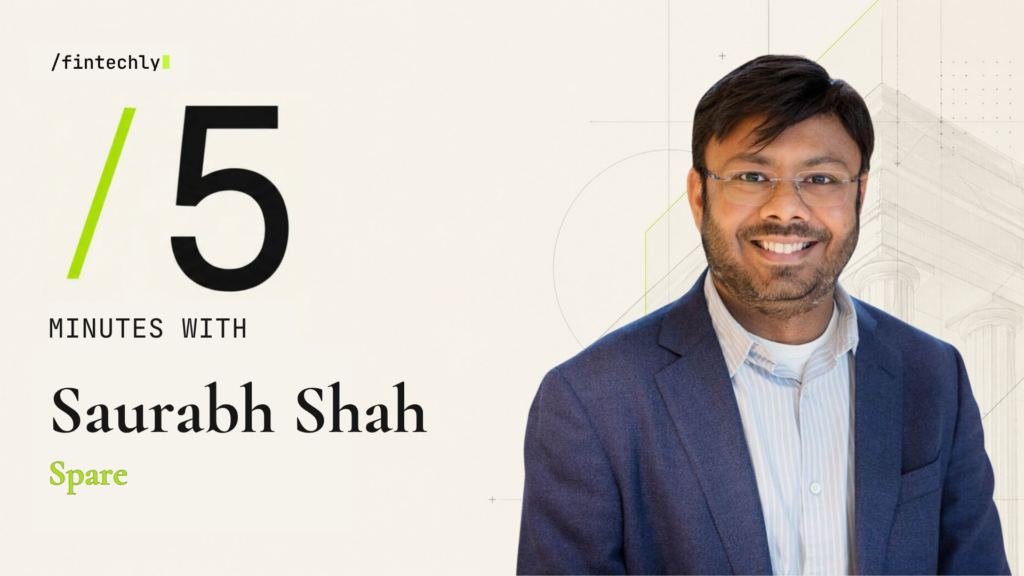
Saurabh Shah spent a decade inside BCG’s financial services and utilities practice before co-founding Spare, building the Open Finance infrastructure that now powers Pay-by-Bank and financial data-sharing tools across a range of partner platforms, most recently Rentify’s lease-renewal affordability checks. We spoke to him about how that infrastructure holds up across such different use cases, what Rentify’s affordability check actually pulls from a tenant’s bank, and what actually replaces a post-dated cheque once Spare’s rails take its place.
You started at Mu Sigma in data and analytics, then spent years as a BCG Partner in London advising financial services and utilities clients on large-scale technology and operations transformations. What did a decade of watching banks try, and often struggle, to modernise their own infrastructure teach you?
I have seen production systems older than every person maintaining them. I witnessed this across large companies of every sector, utilities, banks, airlines. It was always the same, layers built on layers over decades.
The reason modernisation fails is that nobody along the chain is solving the same problem. Leadership funds a one-off tech modernisation programme based on a promise to either cut costs or lift customer satisfaction. Procurement, brought in late and measured on process, optimises for what it can control, checklists, contract wrangling, weeks on a clause nobody will ever invoke. Delivery teams inherit an estate where a change to one system quietly breaks three others. And the business that is the end-user was never asked what it needed, so new technology gets bolted onto old workflows. The result, either the workflow breaks, or the product is customised into oblivion, neither delivers the outcome.
That said, I have also seen modernisation work. The pattern was never fixing the legacy estate issue by issue. Instead, it was standing up a new business alongside it, its own teams, its own technology, its own processes, its own business model, and then migrating customers across. The leadership discipline that made it possible was the willingness to say no. No to preserving old workflows, no to expanding scope, no to treating it as a conventional IT project. Technology only sticks when the operating model is built new rather than patched.
In the past year, Spare has partnered with Rewa on rental payments, Xsquare on business payments, Tabadulat on investment accounts, and now Rentify on lease-renewal affordability checks. That’s four different verticals in roughly twelve months. Is that a deliberate horizontal infrastructure strategy, or is Spare spreading across every use case before proving sustained volume in any one of them?
We built an Account Information and Payment Initiation infrastructure on top of the UAE Central Bank’s Open Finance Framework, which allows us to provide our Pay-by-Bank and financial data sharing infrastructure as a service to all sectors and platforms that can benefit from it for their end users.
We provide the rails and what changes is the workflow the partner wraps around it. Rewa needed to replace post-dated cheques. Xsquare needed to cut card processing costs on B2B payables. Tabadulat needed faster, verified funding into investment accounts. Rentify needed affordability checks embedded into lease renewals. Four different problems, one infrastructure layer underneath. We’re not dependent on any single vertical’s timeline to prove the model works, and every new partner integration makes the underlying rails more resilient.
Rentify’s Renewal Command Center uses Spare’s Open Finance rails for affordability checks during lease renewals. Concretely, what financial data does that check actually pull, and which banks or institutions are live and connected on Spare’s side today, not banks Spare could theoretically reach, but banks actually integrated right now?
On the data side, an affordability check through our rails works through our Account Information Services. With the tenant’s consent, we pull verified account data directly from their bank, things like account ownership verification, transaction history, income patterns, and average balances, and turn that into a structured risk and affordability signal that a partner like Rentify can act on. It’s bank-sourced real-time data, accessed through regulated Open Finance connections, with the customer’s explicit consent at every step. This is available through the banks that are already live on CBUAE’s Nebras rails, with more joining every week.
In the UAE specifically, a post-dated cheque has functioned as more than a payment method, it’s been a landlord’s actual security instrument, real recourse if a tenant stops paying. As Spare’s rails replace that habit across partnerships like Rewa and now Rentify, has Spare built or is it planning any equivalent security or recourse mechanism, or is that simply outside Spare’s remit and left for landlords and property managers to solve themselves?
This is something we think about closely. The post-dated cheque has played a real role in the UAE rental market and it gave landlords a tangible sense of security. As we move that relationship onto digital rails, we’re very conscious that the comfort it provided, not just the mechanics, needs to be replaced. Today, that protection sits in the contractual layer, the agreement between landlord and tenant remains the enforceable route if a payment fails. Operationally, we also build in safeguards to reduce the likelihood of a missed payment in the first place, for example, checking a tenant’s affordability at the time of onboarding, checking their balance ahead of a scheduled payment, alongside retry logic and partial payment handling to manage things when a payment doesn’t go through.
We’re actively exploring, together with the regulators, how to build stronger guardrails into the system itself. It’s an evolving roadmap, and protecting landlords is very much part of it.
In the coming 12 months, what major milestones are you planning, and how do you expect Spare itself, not just its partners, to look different by then?
Over the next twelve months, we’re focused on three things: expanding our coverage of supported institutions, moving into more advanced financial use cases, and scaling up so we’re handling massive volumes.
What gets me excited is how much wider Open Finance is getting. It started with retail banking. The UAE already brings insurance into scope, wallets and investment platforms are the obvious next categories, and business accounts are coming into scope alongside them. Every category that comes in compounds what can be built on top.
For Spare, the real win over the next year is becoming an essential payment and data rail to our clients. Today, a company might plug us in for a quick account check or payment. A year from now, we want them launching three or four different products on our rails. That’s how we become core to their day-to-day operations.