
Cryptocurrency scams received at least $14 billion on-chain in 2025, according to Chainalysis’ 2026 Crypto Crime Report, and pig butchering scams remain one of the two categories driving that total.
The report positions the fraud as an industrial supply chain, a shift that has implications for banks, exchanges, and payment providers across Singapore and the wider region.
Chainalysis projects the 2025 figure could exceed $17 billion once more illicit wallets are identified, up from an initial $9.9 billion reported for 2024 and a revised $12 billion at the time of writing.
What has changed is the volume and its severity. The average scam payment climbed from $782 in 2024 to $2,764 in 2025, a 253% YoY jump.
Pig butchering and high-yield investment programs remain the dominant categories by volume, and the report notes that traditional categorisations are blurring as fraudsters bolt together impersonation, social engineering, and technical exploits inside the same operation.
Southeast Asia is still the centre of gravity
Chainalysis’ on-chain analysis continues to place East and Southeast Asia at the heart of the pig butchering ecosystem.
The firm points to a ‘holiday effect’, a measurable dip in pig butchering scam inflows during the seven-day Chinese New Year public holiday, first observed around 2022 when Huione Guarantee began playing a central laundering role for compounds such as KK Park.
After detrending and seasonal adjustment, average daily activity drops noticeably during that window, an indicator that operators in the region are directly running the flows.
The scale is substantial. Chainalysis’ research finds that pig butchering networks across Southeast Asia, drawing heavily on Chinese-language money laundering networks (CMLNs), generate billions of dollars annually and rely on layered wallet structures, exchanges, shell companies, and informal banking channels to convert crypto into real estate and luxury goods.
In the Tickmilleas case cited in the report, a scam domain used by a fraud network operating from the Tai Chang compound on the Myanmar-Thailand border was registered through a Singapore-based registrar in November 2025.
Blockchain analysis showed victim funds funnelled through US crypto exchanges, then rapidly split across multiple wallets, behaviour Chainalysis describes as the hallmark of professional cross-border money laundering.
The Prince Group case reset the enforcement bar
The single largest disruption of the year came in October 2025, when the US Department of Justice unsealed charges against Prince Group chairman Chen Zhi for allegedly directing forced-labour scam compounds across Cambodia.
The indictment, filed in the Eastern District of New York, charged Chen with wire fraud conspiracy and money laundering conspiracy for directing Prince Group’s operation of forced-labour scam compounds, where individuals held against their will conducted pig butchering schemes.
Alongside the indictment, US authorities filed a civil forfeiture action for approximately 127,271 Bitcoin, worth about $15 billion, said to be the largest forfeiture action in DOJ history.
In coordinated action, OFAC and the UK’s Foreign, Commonwealth and Development Office designated 146 targets within the Prince Group Transnational Criminal Organisation. FinCEN separately used its Section 311 authority to sever the Huione Group from the US financial system.
Chen was arrested in Cambodia in January 2026 after his Cambodian citizenship was revoked and was extradited to China rather than to the United States, where he faces indictment.
AI is multiplying the take per operation
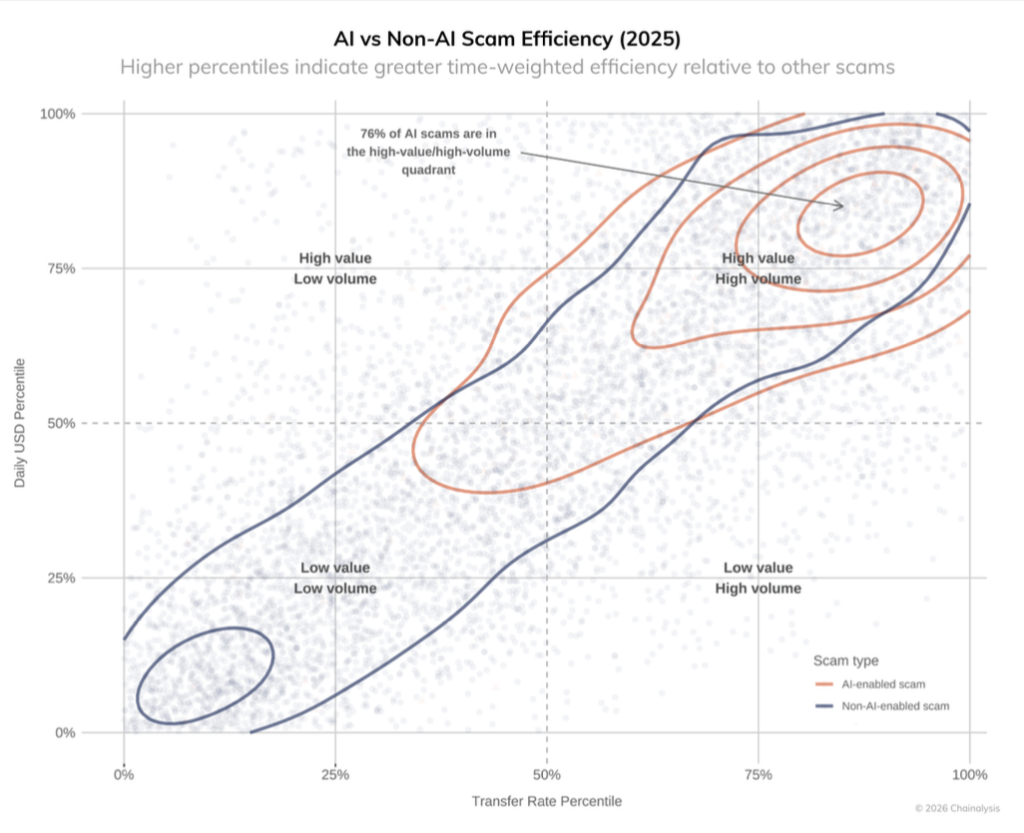
The report’s most striking data set concerns artificial intelligence. Chainalysis identified scams with visible on-chain payments to Chinese AI vendors selling deepfake tools, face-swap software, and large language models, then compared them to scams without those payment trails.
The gap is significant. AI-linked scam operations extracted $3.2 million per operation, against $719,000 for those without an on-chain AI vendor link; 4.5 times more revenue per scam.
Median daily revenue for AI-enabled scams was $4,838 compared with $518, and they averaged 35.1 transfers a day against 3.89.
Chainalysis interprets the transaction volume increase as evidence that AI is helping scammers reach and manage more victims simultaneously, consistent with the broader industrialisation trend.
Purpose-built phishing infrastructure produces even sharper differentials. Scams leveraging commercial phishing kits were 688 times more effective in dollar terms than regular scams, while those buying bulk social media profiles were 238 times more effective. According to Cisco Talos figures cited in the report, tiers ranged from $20 for updates to $50 for a “full-feature development” package.
Laundering has moved towards Chinese-language networks
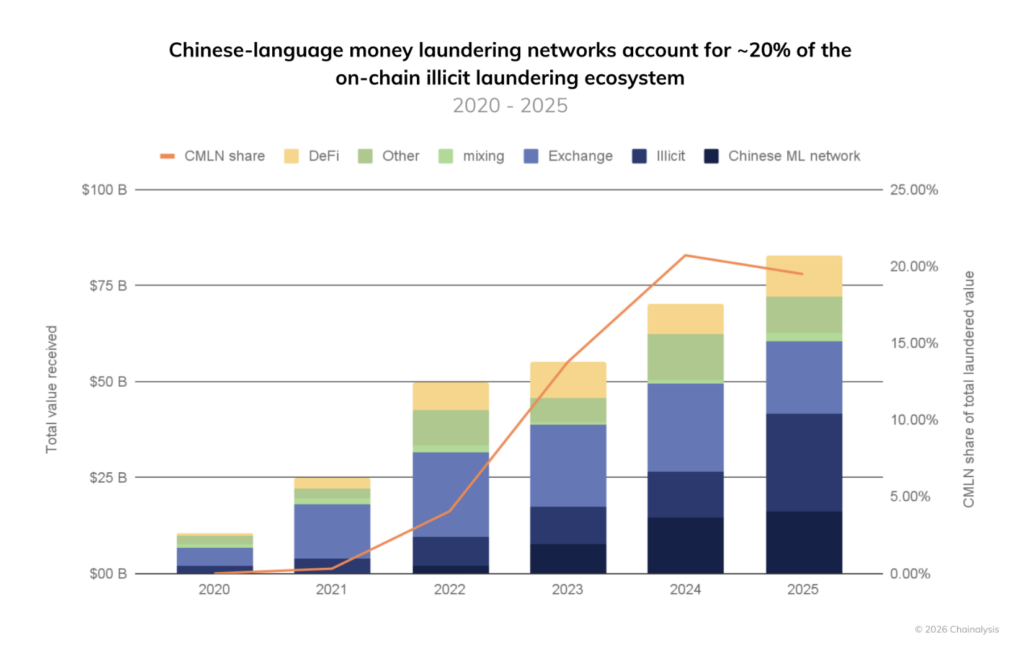
One of the sharper trends in the report is the migration of pig butchering laundering flows away from centralised exchanges and toward Chinese-language money laundering networks (CMLNs).
In Q1 2022, less than 1% of pig butchering laundering flows moved through CMLNs. By Q1 2024, these services processed slightly over 20% of quarterly flows, and they consistently laundered over 10% of scam funds through 2025.
Chainalysis links the shift directly to enforcement pressure: the growth in CMLN use has coincided with a steady decline in centralised exchange use for laundering and off-ramping, potentially because exchanges can freeze funds.
Compliance friction at licensed venues has pushed operators toward informal networks that are harder to disrupt, even after the Huione shutdown.
The firm describes the CMLN build-out as evidence of a persistent, multi-year interconnection between pig butchering scams targeting individuals in the US, Canada, Europe, and elsewhere, and Chinese-language laundering services based in Southeast Asia.
The human trafficking side of the equation is scaling in parallel. Chainalysis identified cryptocurrency flows to suspected human trafficking services totalling hundreds of millions of dollars in 2025, an 85% YoY increase.
The firm notes that this surge tracks closely with the growth of Southeast Asian scam compounds, online casinos and gambling sites, and the CMLN and guarantee networks operating largely via Telegram, a rapidly expanding local illicit ecosystem with global reach.
Expect scam methodologies to converge further
Chainalysis expects further convergence of scam methodologies into 2026, with operators adopting multiple tactics and technologies simultaneously rather than running discrete scam types.
Its policy recommendations centre on three pressure points: broader adoption of real-time fraud and mule detection systems at financial institutions and crypto businesses, faster cross-border coordination to trace and freeze funds before cash-out, and international capacity building in low-capacity jurisdictions where compound operators have historically found shelter.