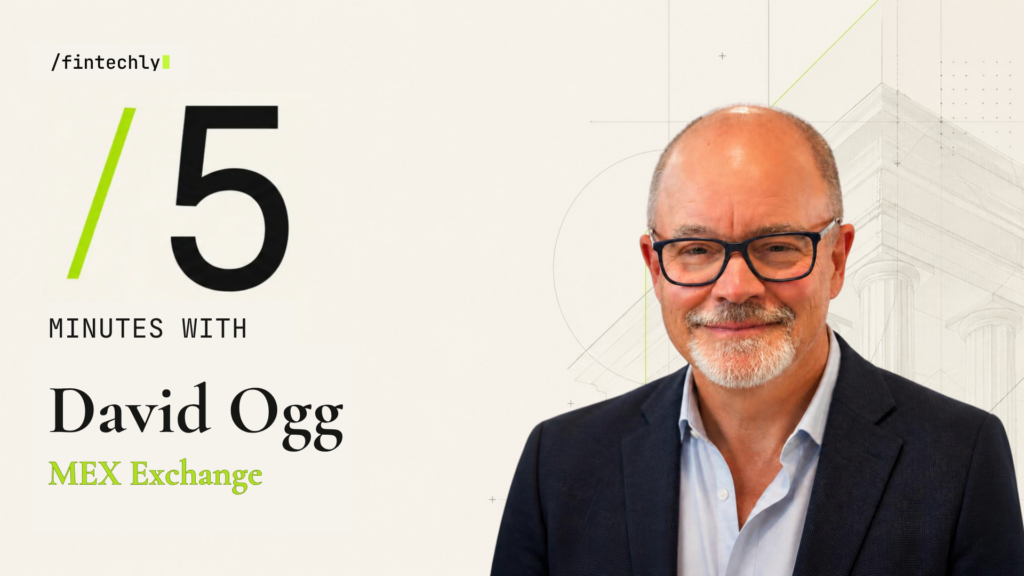
David Ogg co-founded HotspotFX, the first institutional FX ECN, in 1999. Knight Capital bought it in 2007, and it is now part of Cboe FX. He then built LavaFX and joined MultiBank Group to launch MEX Exchange, the Dubai-based ECN it opened in May 2024 for banks and institutions in the GCC and BRICS markets. At the end of August he moved from CEO to Vice Chairman, with former chief product officer Brian Andreyko taking over day-to-day. We asked Ogg what his first ECN taught him, how an ECN stays neutral when its parent group runs a CFD brokerage, and what the only ECN based in the GCC and BRICS actually means.
You built HotspotFX in 1999, it became the reference point for what an institutional ECN is, and it eventually passed through Knight Capital into what’s now Cboe FX. More than twenty years and one full ownership cycle later, what did that journey teach you about what actually makes an ECN durable, and how much of MEX Exchange is a deliberate correction of something you’d change about how HotspotFX ended up being owned?
David Ogg: An ECN remains durable only if it solves a genuine market need and continues to innovate as that market evolves. HotspotFX did that by becoming the first FX ECN to bring banks and buy-side institutions together in an all-to-all environment. It also pioneered the use of prime brokerage on an ECN, enabling buy-side firms to trade anonymously with one another in the name of their prime broker.
Innovation cannot stop after launch. When I later founded LavaFX, now part of LSEG, it became the first FX ECN to offer algorithmic trading tools. That same principle is central to MEX Exchange.
It is not simply an attempt to recreate HotspotFX or a reaction to its subsequent ownership. It applies the lessons learned from that journey: address an underserved part of the market, maintain a neutral institutional environment and keep investing in the product.
MEX Exchange combines a broad suite of institutional products with the fastest FX matching engine operating in nanoseconds and the premier trading front end.
An ECN’s entire value proposition rests on neutral, best-execution order matching, no dealing desk, no conflict between the platform and the client’s fill. MultiBank’s core business is CFD and retail FX brokerage, a model that by design takes the other side of client trades in many cases. How do you keep MEX Exchange’s execution genuinely independent of that, structurally, not just by policy, and would an institutional counterparty be right to ask that question before connecting?
David Ogg: MEX Exchange is operated separately from MultiBank Group’s retail FX and CFD brokerage business. It has no internal dealing desk and does not warehouse risk or take the other side of participants’ trades.
Instead, it matches counterparties through the ECN and uses a network of prime brokers, including MEX Prime, to facilitate trading and credit relationships.
Strict operational and policy boundaries separate the two businesses. We are also prepared to explain that structure directly to institutional counterparties as part of their due-diligence process.
You’ve positioned MEX Exchange explicitly around BRICS and GCC liquidity, markets some Western ECNs have underserved. BRICS membership includes countries under varying degrees of Western sanctions regimes. What does that mean in practice for MEX Exchange’s compliance architecture, counterparty screening and correspondent banking relationships, when a platform’s entire pitch is opening up liquidity that established Western ECNs have been more cautious about?
David Ogg: Our position is unequivocal: sanctioned entities are not permitted to join the platform. Expanding access to underserved markets does not mean compromising compliance standards.
There remains a substantial number of legitimate, well-regulated institutions across the GCC and BRICS markets that lack efficient access to global liquidity despite not being subject to sanctions. MEX Exchange is designed to serve those institutions within the applicable regulatory, counterparty-screening and banking requirements.
Subject to eligibility and compliance checks, MEX Prime can also provide qualifying firms that do not have access to a Western prime broker with connectivity to both our liquidity pool and established Western ECNs.
MultiBank already holds 18-plus regulatory licences and runs roughly $35 billion in average daily volume across its existing business. Why did serving institutional and interbank liquidity require standing up an entirely separate ECN, MEX Exchange, rather than building institutional-grade execution into MultiBank’s existing infrastructure?
David Ogg: Institutional and retail markets have fundamentally different requirements. They differ in the types of clients that can be onboarded, the regulatory and credit standards that apply, and the way orders and counterparty relationships must be handled.
Creating MEX Exchange as a separate institutional platform allows us to maintain the structure an ECN requires. Participants must be confident that they are trading in a neutral environment where orders are matched without an internal dealing desk operating behind the scenes.
Keeping the ECN operationally separate from the retail business provides the clarity and independence institutional counterparties expect.
You’ve called MEX Exchange the only ECN inter-bank platform based in the GCC and BRICS countries. Is that a claim about geography, being headquartered there, or a claim about actual liquidity sourced and matched from banks in those markets? And which specific banks or liquidity providers in the GCC or BRICS are live participants today, not prospective ones?
David Ogg: It is a claim about both geography and the market we serve. MEX Exchange is based in the region, but its significance goes beyond the location of its headquarters. We source liquidity from the GCC and other regions worldwide, allowing institutions in historically underserved markets to access deeper liquidity and more competitive pricing.
The model also works in both directions. Regional institutions can use the platform not only to access global liquidity but also to distribute their own pricing internationally, particularly in currency pairs where they have specialist expertise.
We do not publicly identify individual participating banks or liquidity providers because those relationships are confidential and the platform is designed to support anonymous trading.