Stablecoins have become one of the most widely used assets in digital markets, but much of that capital still sits idle.
RealFi is trying to change that through USDr, a yield-bearing stablecoin pegged to the US dollar and designed to give holders exposure to real-world market investments. The platform is built on Cardano and integrated with Lace, with a focus on turning passive stablecoin balances into assets that can generate returns without users leaving crypto-native infrastructure.
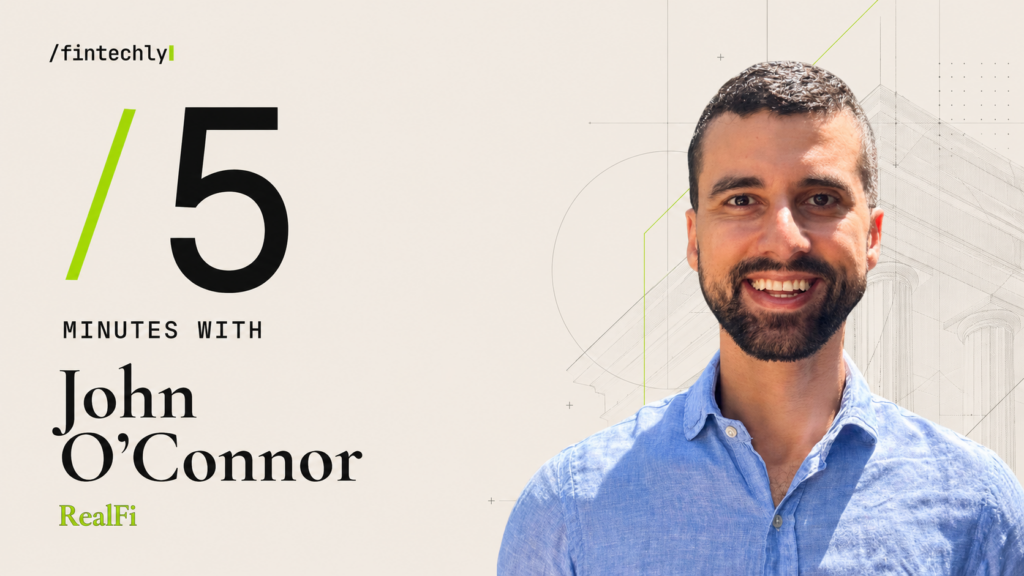
In this week’s Five Minutes With…, Fintechly speaks to John O’Connor, CEO and founder of RealFi, about his route from advertising technology into blockchain, why stablecoins are becoming a larger part of the financial infrastructure debate, and what it takes to build trust in digital asset markets beyond the usual crypto cycles.
John, can you tell us about yourself and what brought you to this point in your career?
My route into fintech wasn’t linear. I started out in advertising technology, handling business development and product roles, before moving into blockchain as part of the early Cardano ecosystem. Being one of the first hires there was a highly formative experience – it exposed me to both the massive potential and the early limitations of digital asset infrastructure.
From there, I focused on applying blockchain to tangible, real-world contexts, which included leading operational teams in Africa and deploying national digital identity systems at scale. What ultimately brought me to this point was a desire to stop optimising existing legacy setups and instead use programmable infrastructure to redesign how capital moves, how access is granted, and how trust is established.
What problem or opportunity are you most focused on right now?
Right now, we are entirely focused on making stablecoins productive. Today, a massive share of stablecoin capital sits completely idle as digital cash without contributing to actual economic activity. The alternative has been crypto-native yield, which is highly volatile and tightly correlated to speculative market swings.
Our biggest focus is bridging this gap by connecting global on-chain liquidity directly with real-world credit markets. Through USDr, we’re enabling users to tap into stable yield derived from diversified, cash-flow-generating private credit and fixed income, while simultaneously directing capital toward underserved businesses that traditional financial systems leave behind.
What do you think deserves more attention than it is getting in your part of the industry?
The gap between pure innovation and operational discipline. The digital asset space is incredibly effective at generating brilliant new ideas, but it is far less consistent when it comes to building sustainable, resilient systems around them. People over-index on flash narratives rather than core economic fundamentals.
We need a much stronger, collective alignment between innovation, risk management, and regulatory compliance. Without prioritising that discipline, it becomes impossible to build the kind of infrastructure that institutions and everyday users can genuinely rely on over long horizons.
What do you think people still misunderstand about your part of the industry?
People still think that blockchain utility is entirely abstract or siloed within a speculative bubble. There’s a misconception that you either choose traditional banking or pure DeFi, keeping users at arm’s length on both sides. In reality, the technology is ready to serve as a practical foundation for global economic primitives. When you use it to upgrade the back-end ‘plumbing’ of credit and money, you aren’t just changing a user interface – you are rebalancing geographic inequalities, unlocking capital efficiencies, and allowing systems to operate across borders with a level of openness traditional rails simply cannot achieve.
What do you expect to rise up the agenda over the next year?
The conversation is going to shift heavily toward how stablecoins evolve beyond mere payment tokens into foundational financial infrastructure. That means defining exactly how stablecoin yield is sustainably generated, how underlying risk is managed, and how these models seamlessly integrate within global regulatory frameworks.
As digital assets intersect more directly with traditional financial systems, interoperability between on-chain and off-chain markets is going to become a dominant agenda item. Rebuilding institutional trust through deliberate, robust scaling is going to take centre stage.
Bonus question: What’s the one question about RealFi we should have asked: and what’s your answer?
You should have asked: ‘Why choose a slower, deliberate approach to scaling when the crypto market rewards speed?’ My answer is that one of the most valuable mistakes of my career was underestimating how long it takes for new financial infrastructure to gain traction.
Financial systems require deep trust, regulatory alignment, and behavioural changes before they truly shift. At RealFi, we deliberately prioritise robustness, credibility, and sustainable risk architecture over rapid expansion. Success in this space isn’t about moving fast and breaking things; it’s about building a credible bridge to legacy markets that can stand the test of time.
.