More and more businesses want to own their payments rather than hand the whole process to someone else. Software platforms, marketplaces and larger merchants can see the revenue, the data and the customer relationships that sit inside payments, and they want a bigger share of all three. The obstacle has always been the cost of ownership. Becoming a payment facilitator or an acquirer in your own right has traditionally meant scheme membership, regulatory licences, risk infrastructure and years of investment, which puts it out of reach for all but the largest players.
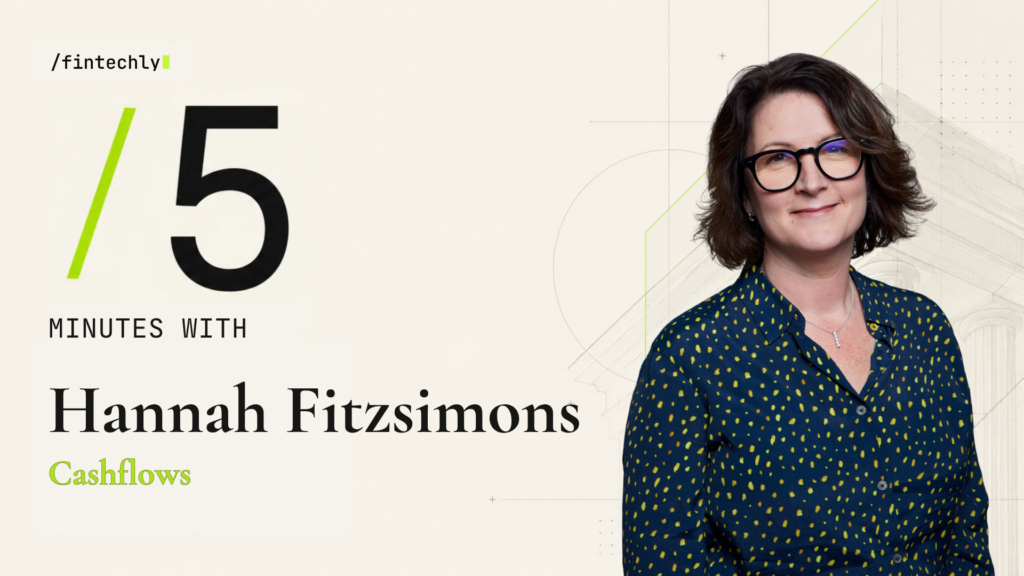
Hannah Fitzsimons, CEO of Cashflows, thinks that trade-off is starting to break down. Through the company’s Shift proposition, Cashflows partners with business to leverage its licences, expertise and infrastructure to allow them to take control of their payments without building a regulated payments company from scratch.
In this week’s Five Minutes With…, Fintechly speaks to Fitzsimons about why payments ownership is democratising, what embedded payments really offer beyond a new revenue line, the misconceptions that keep businesses dependent on their acquirer, and why she believes control and partnership are not opposites.
Hannah, can you tell us about yourself and what brought you to this point in your career?
I have spent most of my career in payments and financial services. I joined Cashflows as CEO in May 2022, after more than fifteen years at Elavon, where I worked my way up to President and General Manager for Europe. Before that, I held senior roles at Citibank and Natwest, so I have seen this industry from the perspective of large banks and of specialist payments businesses.
Cashflows was founded in 2010 to make accepting payments as simple as possible, with an end-to-end offering built in-house. We are authorised by the FCA, and we were one of the first independent UK payments institutions to become a principal member of both Visa and Mastercard. That combination of licences and proprietary technology is what now lets us extend the same capabilities to other businesses through Shift.
Alongside the day job, I care a great deal about representation. Only a small single-digit percentage of fintech CEOs globally are women, and that shortage is self-perpetuating, because it leaves the next generation without role models.
What problem or opportunity are you most focused on right now?
Payments ownership is a key area we are starting to move the dial in. For years, businesses faced a binary choice. Either you handed your payments to an acquirer and accepted the limits that came with that, less control, less margin, less insight, or you committed enormous time and money to becoming a regulated payments business yourself. For most, the second option was never realistic.
That is the trade-off we are working to remove with Shift. We let ISVs, ISOs, payment facilitators, acquirers and enterprise merchants to partner with us to take on more of the payments journey without the upfront cost, risk and delay of doing it alone. A software platform can move into the market quickly across the UK and EEA, manage its own risk approach and put its own brand front and centre, with Cashflows providing the licensed infrastructure behind it.
What excites me is that this used to be the preserve of the very largest companies. Making it accessible to mid-sized and growing businesses genuinely changes what they can build.
What do you think deserves more attention than it is getting in your part of the industry?
In my view, that’s how much value businesses leave on the table by treating payments as a cost to be outsourced rather than an asset to be owned. Payments carry revenue, data and the customer relationship, and when you hand all of that to a third party, you hand away the chance to monetise it, to learn from it and to shape the experience your customers actually receive.
Then there is a related point about education. The payments industry has become far more intricate over the last decade, with new practices, new regulation and layers of infrastructure that most business owners were never equipped to navigate. Too often the sector hides behind that complexity instead of explaining it. If more providers were honest and clear about what ownership involves and what it can return, many more businesses would realise that taking control is within reach.
What do you think people still misunderstand about your part of the industry?
That owning more of your payments is simply about unlocking upside. Businesses tend to focus on the revenue share, the control and the customer relationship, and they underestimate that ownership and accountability move together. Every step further into the payments journey brings more responsibility, particularly around risk, compliance and regulation, and that is something to be managed properly, not a switch you flip once.
Another way to think about it is by maturity. The right model for a business will depend on where it is on its journey. We can support an ISV or ISO in whatever model suits them, from PayFac as a Service at one end through to full BIN sponsorship at the other, but the honest conversation is about how much accountability they are ready to take on and manage today. A business can start where it is comfortable and assume more as it builds the capability and confidence to carry it. That progression over time is the point, not a compromise, and it is our job to make sure each stage is one they can genuinely own.
What do you expect to rise up the agenda over the next year?
Embedded payments and the build-versus-partner question that comes with them. As more platforms and merchants decide they want to own payments, they will have to weigh building that capability in-house against partnering with someone who already holds the licences and carries the regulatory weight. I expect a lot of firms will conclude that the smart move is to focus on their own product and customers and let a licensed partner handle the parts that are genuinely hard to build and expensive to maintain.
Alongside that, I would like to see representation continue to climb the agenda. The businesses making these decisions are stronger when the people making them reflect the customers they serve, and fintech still has a long way to go on that.
Bonus: What’s the one question about your company we should have asked, and what’s your answer?
“If you are helping businesses take control of their own payments, are you not doing yourself out of a job?”
My answer is that control and partnership are not opposites. Shift is built on the idea that a business can own more of its payments journey with us right behind it. We hand over the capability, but we stay alongside as the licensed partner carrying the regulatory and scheme responsibility, so the business gets independence without being left exposed.
That fits how I think about business more broadly. The way I try to run Cashflows is by listening to as many viewpoints as possible, from employees to customers to partners, and by keeping the promises we make. Payments ownership only works if there is trust and a real relationship underneath it, and for me that human connection is the point, not an afterthought.