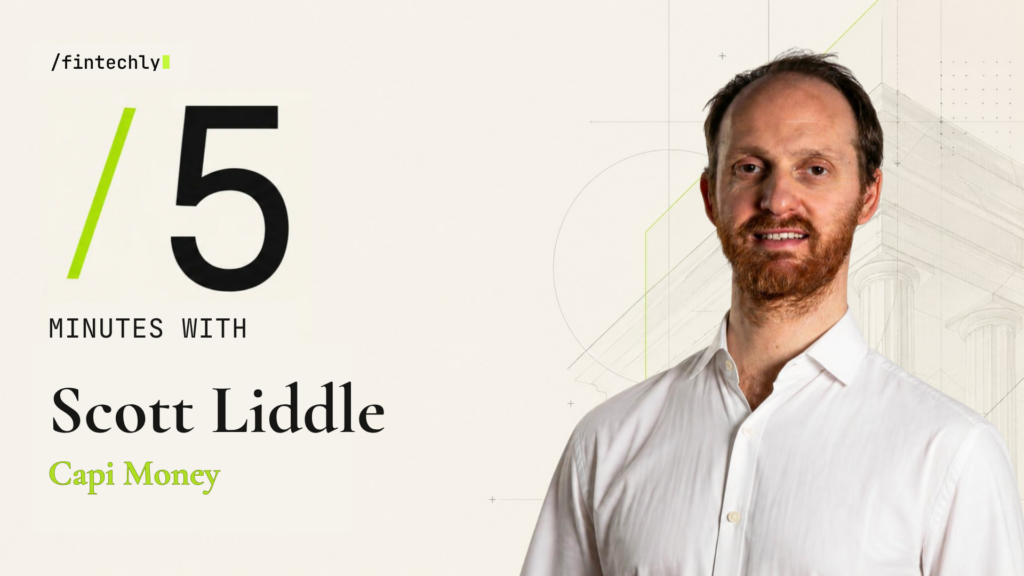
Capi Money co-founder Scott Liddle on why emerging markets trade is held back by a lack of trust between business counterparties, not a shortage of technology.
Scott Liddle co-founded Capi Money in 2023 after seeing, at fintech startup TaptapSend, how hard it still is for businesses in emerging markets to move money across borders — not because the technology is missing, but because counterparties on opposite sides of a trade rarely have any relationship of trust.
In this week’s Five Minutes With…, Fintechly speaks to Liddle about why stablecoins aren’t the silver bullet some assume, the growing pull of de-dollarization on emerging markets trade, and what Capi’s rapid growth into a hundred-strong team says about the size of the opportunity.
Can you tell us about yourself and what brought you to this point in your career?
I started my career in the humanitarian sector in Algeria and Afghanistan, before moving to London to work for Rory Stewart when he was Secretary of State for International Development. I co-ran Rory’s campaign as candidate for Mayor of London, until it was brought to an end by COVID.
Finding myself unemployed, I jumped at the opportunity to work with fintech startup TaptapSend, launching new markets across Africa and Asia. TaptapSend is an app for members of the diaspora who need to send money home, taking on legacy players like Western Union. I spent two and a half years there, as Taptap became valued at a billion dollars in under 4 years.
At Taptap, I met my co-founder, Mitch, and we became interested in the adjacent problem of businesses in emerging markets that need to send funds cross-border. It turns out that is still a very difficult thing to do in many parts of the world.
That insight led us to set up Capi Money in 2023. We were backed by US accelerator Y Combinator as well as Firstminute Capital in the UK, which enabled us to accelerate our launch in West Africa and gain early traction.
What problem or opportunity are you most focused on right now?
The problem we’re focused on right now is providing the global business account for emerging markets traders. We let businesses make international payments, do FX conversions, and have corporate cards that allow multi-currency spend without limits across the world. Capi allows businesses to hold funds in foreign currency, earn interest on those funds, and, eventually, access trade credit to fund their imports. We’re building the one-stop financial platform that will essentially replace banks in emerging markets trade.
In emerging markets, $10 trillion of goods are imported every year. Each of those imports needs to be paid for, and those funds typically have to move from one country to another, which still happens on antiquated rails — primarily the SWIFT system — passing through a long chain of correspondent banks. This is slow, sometimes unreliable, and the originating banks on the emerging market side often aren’t offering a high standard of service either, e.g. the norm is still to bring hard copies of paperwork to the bank to sign in person rather than to make digital transactions.
What do you think deserves more attention than it is getting in your part of the industry?
There’s a very interesting question around stablecoins. We use stablecoins ourselves — we offer our customers the ability to pay their suppliers in stablecoins, and we also use stablecoins to manage our own treasury and liquidity.
But we often see stories about stablecoins “solving” the emerging markets payments and FX problem, which isn’t the case. On the ground, traders sell goods locally and derive their revenue in local currency. That could be West African francs or Kenyan shillings, for example. Those funds need to be converted into a foreign currency that will be accepted by a supplier or other counterparty around the world — that could be USDC or USDT, of course, or just USD fiat, Euro fiat. But that first-mile piece — the initial collections, doing that in a compliant fashion and then reliably converting it into foreign currency — that is where a lot of the work happens. None of that work is taken away by using stablecoins.
So that’s why we’ve taken the decision to have people on the ground, entities on the ground, licenses on the ground, on the emerging market side, so that we can make that first mile as seamless as possible.
What do people most often get wrong about what your company does?
It’s easy to think B2B cross-border payments is just a scaled-up version of consumer remittances. Whereas actually what we’re solving is a lack of connection between business counterparties.
In a consumer remittance transaction, there’s natural trust — parties are often family members or friends. Whereas in business, an importer in Senegal buying goods from an exporter in China has no particular relationship of trust. At Capi, we help provide that trust — by being regulated in tier 1 jurisdictions that exporters trust (we’re regulated by the FCA in the UK), by making payments fast so nobody has to wait, and by holding high compliance standards.
Recently, for example, we launched corporate cards in beta and saw customers often using them to buy software like Google ads or AI tools. When we dug into why they used the Capi card rather than their local bank card, it’s simply that those software providers don’t accept a card from, say, Senegal, whereas our card is issued in the US. That’s because they haven’t spent the time optimizing acceptance in emerging markets. So when we issue an international card for these businesses, their payments go through, Google is happy because they get more ad spend and our customer is happy because they get access to the same tools western businesses take for granted.
What do you expect to rise up the agenda over the next year?
The question of de-dollarization, and broader decoupling in the global economy, will continue to shoot up the agenda. Situations like the ongoing conflict in Iran, and the secondary sanctions the US wants to place on financial institutions around the world that deal with Iran — including in places like the UAE, and potentially even China and Hong Kong — will continue to push in the direction of excluding actors from accessing the dollar and the SWIFT system, just as Russia has been kicked off SWIFT. This is going to create a more fragmented, multipolar economic picture.
We see it already. The single largest destination for transactions on our platform is China and Hong Kong, because they’re exporting a lot of goods to Africa. We ourselves have started offering alternative ways of paying suppliers in China beyond SWIFT — I mentioned stablecoins, but we also offer Alipay, a local payment method, and we’ll be offering other China-specific methods in the near future. Alongside that, we’re seeing increasing volumes of renminbi being paid through our platform to Chinese suppliers, rather than US dollars. So I think this will be a continuing theme over the next year.
What’s the one question about your company we should have asked, and what’s your answer?
What are your three coolest moments as a founder at Capi Money?
The first was visiting the offices of one of our largest clients in Senegal, the country’s biggest importer of mayonnaise, and seeing their warehouse piled high with tubs of mayonnaise.
The second was visiting Guangzhou, China, and spending an evening at a Cameroonian restaurant called the Consulate. All the visiting Cameroonian traders gather there in the evening — and we got to witness how large export deals get inked in the small hours of the morning over bottles of whiskey.
The third, and perhaps my proudest moment, is looking back at how just three years ago, my co-founders and I, with a couple of our early colleagues, were doing everything on the front line of this business — from customer service to trading FX to executing payments to responding to banks’ compliance queries. Three years on, we’re more than a hundred wonderful Capitaines across six offices in Europe and Africa, processing well in excess of a billion dollars a year on behalf of businesses in emerging markets. It’s incredible to see how far we’ve come — and even more incredible to think of how far there is still to go.