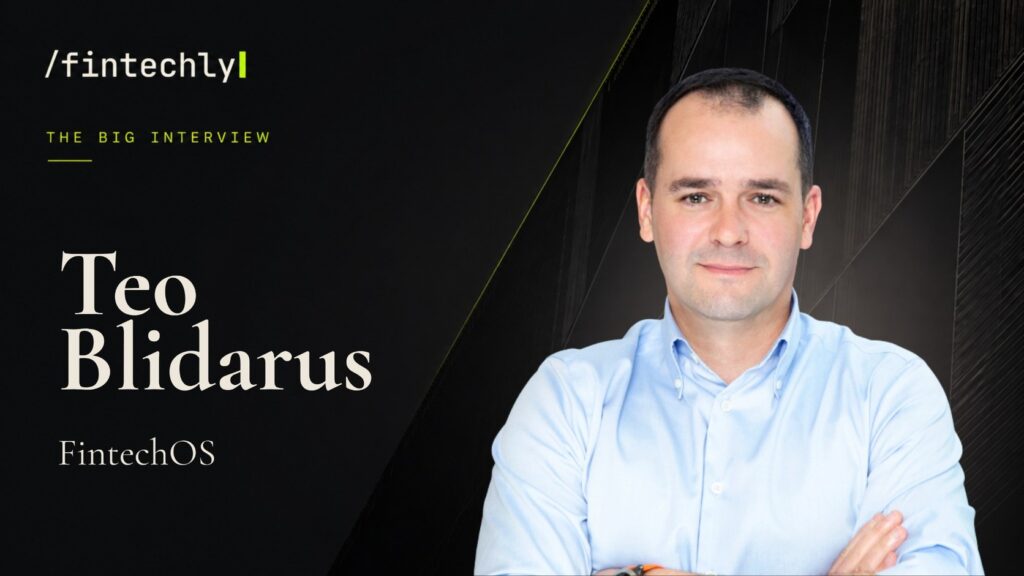
Nine years into building FintechOS, an AI-powered product operations platform for banks and insurers, co-founder and CEO Teo Blidarus has seen the business evolve alongside major shifts in financial technology.
“I would be lying if I said everything was clear from day one and everything went according to plan,” he told Fintechly.
What has remained consistent, he said, is the company’s aim to simplify how technology is used to create and manage financial products.
“We wanted to simplify the way technology is deployed to create better financial services worldwide.”
FintechOS initially developed against the backdrop of growing public cloud adoption. Over the past three years, however, its investment has increasingly centred on artificial intelligence, data access and the fragmented systems used to design, price, launch and service financial products.
That investment is now showing up in both the company’s products and its financial results. FintechOS reached profitability after a period of consolidation in 2023 and 2024, while recurring revenue increased by 40 per cent year on year at the end of the first quarter.
The company is targeting annual recurring revenue of $35 million in 2026.
Making AI part of the operating model
Much of the public discussion around FintechOS’s AI strategy has focused on Dex, its agentic copilot for banks and insurers. The tool enables employees to configure products, rules and workflows using natural-language instructions rather than code.
FintechOS says this approach has reduced the time required to configure product rules by as much as 60 per cent.
Much of FintechOS’s AI story is customer-facing, but the company has also been applying the technology to its own operations. Blidarus linked its use within FintechOS to shorter time to value, stronger margins and a more sustainable business model.
“We started to leverage AI across customer operations, but also R&D operations, and that has had a tremendous impact on our ability to build sustainable growth,” he said.
According to Blidarus, FintechOS’s gross margin has nearly doubled over the past two years, while the time required for the company and its clients to begin gaining value from deployments has fallen.
That operational change helps explain how FintechOS has reached profitability while continuing to grow. It also takes the company’s AI story beyond a product announcement: FintechOS is using the technology to improve the economics of how its platform is developed and delivered.
What profitability changes
Blidarus sees profitability and growth as separate forms of validation.
“Profitability is a game changer, not because you suddenly have more money to spend, but because it proves that you have a sustainable model moving forward,” he said.
“It proves that the company has reached maturity. We understand the market segments in which we can be competitive and, most significantly, it means that we have established the right level of partnership with our customers.”
Profitability does not rule out further fundraising, he added. Its immediate value lies in providing evidence that FintechOS can support customers over the longer term.
That reassurance is especially important in financial services. Banks and insurers look beyond the product itself; they also need to know a provider will still be there through a lengthy implementation and once the system is live.
Blidarus recalled one of the questions FintechOS regularly faced during its earlier stages: “How can you make sure that in two years you’re not going to die?”
Reaching profitability, he said, makes the company “less of an alien and more of a legit part of the ecosystem”.
Growth offers a different signal. While profitability demonstrates sustainability, continued expansion suggests that FintechOS has identified a current problem and a product the market is prepared to buy.
“They are two different points of validation,” he said. “One is sustainability and legitimacy in the industry. The other proves that you are on point with where the market is heading and that you are solving a problem of today.”
Why US growth accelerated
The US has become FintechOS’s fastest-growing market, with revenue increasing by 130 per cent over the past year.
Blidarus acknowledges that the percentage reflects a smaller starting position than in the UK and Continental Europe, where the company has operated for longer. Even so, the US has become an important source of growth, particularly among credit unions and community-focused financial institutions.
The change followed several years spent learning the market, securing early customers and adapting to local regulatory and commercial requirements.
FintechOS also changed how it approached expansion. Rather than attempting to build its US presence alone, it placed greater emphasis on partnerships with established technology providers, including Finastra.
Its platform can be integrated with core or payment infrastructure already used by financial institutions, allowing partners to add modern product capabilities without requiring customers to begin with an entirely new technology estate.
“There is a gap of trust when you are a European company trying to deploy in the US,” Blidarus said.
“It goes beyond the human relationship. It is regulatory, it is knowledge of how the market functions and it is the competitive landscape. It is really difficult to do it by yourself, and we are not doing it by ourselves anymore.”
Partners bring existing customer relationships and market knowledge, while FintechOS provides technology intended to extend the products and services that can operate around their infrastructure.
The arrangement, Blidarus said, can help those providers strengthen customer loyalty while giving FintechOS a more credible route into institutions it would find difficult to reach independently.
Modernisation without replacing the core
Banks and insurers typically approach FintechOS because they want to modernise the systems used to manage their products, Blidarus said.
For a building society, that may mean savings and mortgages. For a lender, it could involve credit cards or vehicle finance, while insurers may be looking to update products across personal lines.
“The name of the game in the industry is: how do we modernise our product stack, make it more customer-centric and drive efficiency through AI?” he said.
Blidarus is less convinced by the assumption that modernisation must begin with replacing a financial institution’s core system.
“Respectfully, I would challenge the question,” he said when asked why core replacement remained so difficult. “I don’t think you actually need to replace the core, and this has been our thesis from the beginning.”
A full replacement may still be necessary where a bank faces a fundamental regulatory or operational limitation. However, he argues that many institutions can gain most of the intended benefit by modernising customer journeys, product systems and operational processes around the core.
“Sometimes technologists like myself get ahead of themselves and put technology in front of customer benefits,” he said.
The difficulties are particularly acute for smaller financial institutions. Credit unions, community banks and building societies may have less money and fewer specialist employees available, despite facing many of the same technology demands as larger banks.
Where an institution might previously have managed one major transformation over several years, Blidarus said it may now need to address several areas at once, including onboarding, pricing, origination, data and artificial intelligence.
A unified product operations layer is intended to reduce the need to procure and integrate a separate platform for each of those functions. It does not remove the need for experienced employees or sound decision-making.
“I still believe natural intelligence is above artificial intelligence,” Blidarus said. “It doesn’t mean it is going to solve all the problems for you.”
Building on existing customers
Although the US offers the largest addressable opportunity, Blidarus said FintechOS’s next stage of growth will not depend solely on entering new markets or winning new logos.
Expanding its work with existing customers is equally important because the full value of the platform emerges as it is used across several product lines.
“For us, the US is only part of the story,” he said. “Growing existing partnerships and existing relationships is equally important.”
In the UK, the company plans to build on its move into building societies and its work with insurers including Howden and Admiral. Credit unions and community banks remain priorities in the US, while FintechOS has yet to launch its insurance proposition there.
The company also plans further investment in customer success as it seeks to expand deployments across the organisations it already serves.
For Blidarus, the combination of profitability, recurring revenue growth and stronger US traction suggests that the difficult decisions made during the consolidation period are beginning to pay off.
AI has contributed to that progress, but the more substantive story is not that FintechOS added an agent to its platform. It is that the company began using the same technology to reconsider how it builds, delivers and supports its products.
“We always wanted to win,” Blidarus said. “But it is important how we are winning as well.”