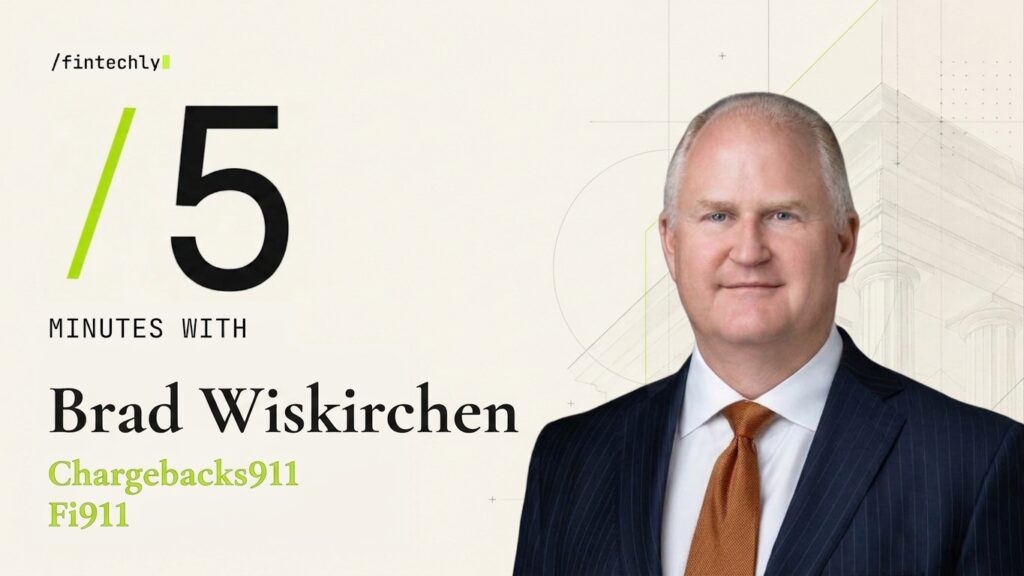
Brad Wiskirchen co-founded Kount, the fraud prevention company that Equifax bought in 2021, then ran Equifax’s digital solutions business and worked as an industrial partner at CVC Capital Partners.
On 15 October, Chargebacks911 named him chief commercial officer and chief executive of Fi911, its sister brand for banks and card issuers. He will lead acquisitions, partnerships and relationships with financial institutions and payment processors. We asked him about running businesses on opposite sides of a chargeback, who pays when an AI agent’s purchase is disputed, how much of the problem is friendly fraud and where banks lose money.
Chargebacks911 works for merchants. Fi911, which you now run, works for the banks that raise chargebacks. How do you keep the two apart?
Brad Wiskirchen: Chargebacks911 and Fi911 are sister companies serving different parts of the payments ecosystem. Chargebacks911 works primarily with merchants, while Fi911 works with banks and card issuers, and each has its own client relationships.
I would challenge the idea, though, that the two sides are naturally in opposition. Chargebacks911 helps merchants prevent avoidable disputes and respond with the right evidence when one is raised, while Fi911 helps issuers handle disputes accurately and efficiently. Neither business exists simply to make one side win regardless of the facts.
When a dispute is resolved on good evidence, the outcome should be better for everybody involved. A merchant that fulfilled a legitimate order should be able to defend the sale, a bank should not have to spend time progressing a case that could have been resolved earlier, and a cardholder with a genuine problem should get that issue addressed as quickly as possible.
Working across both sides of the ecosystem also gives us useful perspective because a dispute is one of the few points where the merchant and issuer are looking at the same transaction from opposite ends, often with different pieces of information. Seeing where that information breaks down helps us understand where unnecessary cost and friction are entering the process and where better technology or better collaboration can make a difference.
When an AI agent’s purchase is disputed, who takes the loss under card scheme rules, and what evidence would a merchant need?
Brad Wiskirchen: Card scheme rules were not designed with autonomous shopping agents in mind. Today, when a cardholder says they did not authorise an online purchase, the loss often lands with the merchant, even when the merchant did everything right, and agentic commerce is going to put that model under real pressure.
Our view at Chargebacks911 is that the starting point should be simple. If a cardholder authorises an AI agent to shop on their behalf, they are responsible for what it buys within the authority they have given it. It is no different from handing your card to your teenager to buy concert tickets. If they also come back with a new pair of trainers, that is a conversation for the family, not grounds to claw the money back from the shop.
When a cardholder disputes a purchase their own agent made within that authority, that is friendly fraud.
If the agent malfunctions or goes beyond what it was asked to do, responsibility should sit with the company providing the agent, the one the consumer chose and pays, rather than with the merchant that fulfilled what appeared to be a valid order. Think of a travel agency: if your agent books you on the wrong flight, you take it up with the agency, not the airline.
The real challenge is evidence, because existing authentication can help establish that the required credentials or checks were satisfied, but it may not establish whether the consumer intended that specific purchase. Our Founder and CEO, Monica Eaton, has described this as “delegated intent”, and I think that is a useful way of looking at the problem.
A merchant defending an agent-initiated transaction would need to be able to show that the consumer authorised the agent to transact, what instructions or limits were placed on it, what was ordered and confirmed, and that the order was ultimately fulfilled.
The industry needs to agree what that record looks like before agent-led transaction volumes grow to the point where dispute volumes force the question, because the evidence standard will ultimately determine whether these transactions can be resolved fairly when something goes wrong.
What share of disputes turn out to be customers misusing chargebacks rather than criminal fraud, and is it changing?
Brad Wiskirchen: It is worth being precise about the terminology first because friendly fraud is a broad term. It covers cardholder-driven disputes where a transaction was legitimate but is later challenged without a valid basis, and that can range from genuine confusion through to deliberate abuse. First-party misuse sits at the deliberate end of that spectrum, and neither should be confused with criminal third-party fraud.
Our internal data puts friendly fraud at 86% of chargebacks, while merchants themselves think the proportion is much lower. In our 2026 Chargeback Field Report, merchants estimated that friendly fraud accounts for 43.8% of their chargeback losses on average. Those figures come from different datasets, so they should not be treated as a like-for-like comparison, but the gap does show how difficult it can be for businesses to understand what is really driving their disputes.
The wider trend points in the same direction. In the report, 74.4% of merchants described friendly fraud as a moderate or significant concern, while 83.4% of enterprise merchants reported an increase in friendly fraud over the past three years. That tells you this is not simply an issue of classification or terminology but becoming a bigger operational and commercial problem for merchants.
There is also a wider cost to consumers. Thirty-eight per cent of merchants said chargeback costs were influencing the prices of their goods or services, up from 32.5% in the previous report, so the impact does not end with the individual dispute. If businesses have to absorb higher fraud and dispute-management costs, some of that cost ultimately finds its way into the prices paid by legitimate customers.
Where do banks lose money in disputes, and what would fix it fastest?
Brad Wiskirchen: The disputed amount itself is only part of the cost for a bank. There is also the expense of receiving the claim, investigating it, managing the evidence and processing the case through the dispute lifecycle. Mastercard research puts the average processing cost for a financial institution at between $9.08 and $10.32 per dispute, so when you multiply that across a large dispute portfolio, the operational cost becomes significant before you even factor in the transaction value.
I would point to three areas where those costs build up. The first is intake. Our Cardholder Dispute Index, based on more than 1,200 cardholders in the UK and US, found that 76.64% go to their bank first rather than the merchant when they want to dispute a transaction. Every one of those contacts potentially becomes a case the issuer has to investigate and process.
The second is write-offs. Sometimes the cost of investigating or challenging a low-value dispute can be greater than the amount at stake, so the institution may decide to absorb the loss rather than spend more money pursuing it. The third is process itself, because dispute operations can still involve fragmented information, manual investigation and legacy systems, all of which add cost and make it harder to establish quickly what actually happened.
The fastest improvement is better classification at the start. A bank needs to establish as early as possible whether it is dealing with criminal fraud, a merchant or service issue, genuine customer confusion or misuse of the dispute process, because those scenarios should not all automatically follow the same journey.
AI and machine learning can help by bringing together transaction information, merchant data and relevant cardholder history to support that early triage. That means genuine claims can move quickly, while the cases that require more investigation receive the scrutiny they need. The aim is not simply to automate more disputes, but to make the right decision earlier with better information, so the bank and the customer spend less time moving through an unnecessarily expensive process.
Bonus: What does the fraud industry still get wrong about what happens after a transaction?
Brad Wiskirchen: I spent years building fraud prevention technology, so I have seen first-hand both what it can do and what it cannot. A fraud decision made before or during a transaction is ultimately a prediction based on the information available at that moment, and while AI and machine learning have made those decisions much more sophisticated, they still cannot tell you everything that will happen after the payment is approved.
A dispute gives you another piece of the picture because it can show that a transaction which looked safe at checkout subsequently caused a genuine problem, but it can also show that a transaction later described as fraud was actually a legitimate purchase the customer then disputed. That makes disputes valuable as a source of intelligence, not simply a cost to be processed.
Our 2026 Chargeback Field Report found that 83.4% of enterprise merchants reported an increase in friendly fraud over the past three years, and that tells you why the post-transaction environment matters. Fraud prevention and dispute management are separate disciplines, but they are connected. What happens after the transaction can tell you something about the decisions made before it, where information is missing, where customers are becoming confused and where misuse is occurring.
As AI agents start making more purchases on consumers’ behalf, that feedback loop is only going to become more important. Knowing that a transaction passed a fraud model will not be enough on its own. We will also need to understand who authorised the purchase, what they intended the agent to do and what actually happened afterwards. That is where I think the next phase of fraud and dispute technology gets interesting.