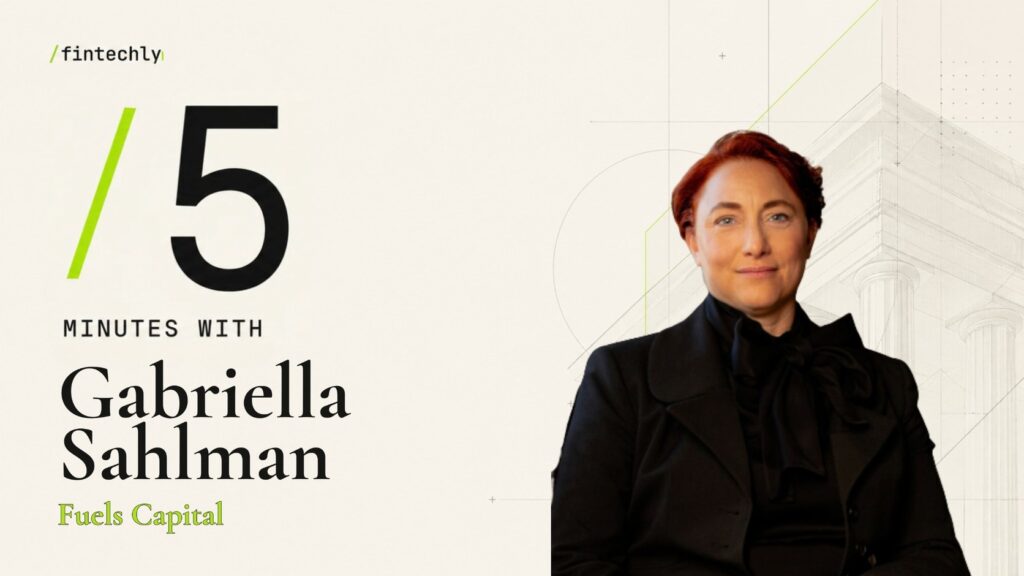
Many mid-sized European companies own valuable assets yet still struggle to secure finance. Lenders often favour predictable cash flow, simple ownership structures and businesses that fit established credit models, leaving entrepreneur-led and growth-stage companies with fewer options.
Gabriella Sahlman, co-founder and managing partner at Fuels Capital, believes asset-backed lending can help close that gap. The Nordic private credit firm, which operates as a distinct business unit within Swedish credit market company and venture builder 0TO9, assesses what a business owns and the value supporting a loan, rather than relying primarily on future earnings.
In this week’s Five Minutes With…, Fintechly speaks to Sahlman about why parts of Europe’s mid-market remain underserved, the misconceptions surrounding complex businesses, the role of asset-backed finance and the pressure higher borrowing costs could place on private credit.
Can you tell us about yourself and what brought you to this point in your career?
I have spent most of my career around fintech. I started my career at OM (today Nasdaq OMX) in the late 1990s, at a time when electronic markets were still transforming the financial industry. I later worked at Orc Software (today part of Broadridge), helping financial institutions and professional traders use increasingly sophisticated trading technology.
Over the years, my focus shifted towards investing, private credit and company building. I co-founded Proventus Capital Partners in 2004, one of the early movers in European direct lending. After that, I worked with the European private credit team at Ninety One and sit on the board of Gilion and Creandum.
What brought me to Fuels Capital was spotting a market gap: about one in four European mid-market companies has no direct access to finance. Despite the boom in European private credit fundraising, capital is concentrated in ‘safe’ bets, namely, sponsor-backed and cash-flow-based deals that already work.
This comes at the expense of businesses with complex structures that spook mainstream lenders. These are typically entrepreneur-led companies, growth-stage businesses, and transitional ventures that fall outside the traditional lending criteria. But that doesn’t make them ‘risky’ bets – oftentimes these companies own real value but simply can’t borrow against it.
After seeing what co-founders Oliver Hildebrandt and Robin Gerum have been building – asset-backed financing for companies traditionally excluded from mainstream financing channels – I knew I wanted in.
What problem or opportunity are you most focused on right now?
Mid-market companies that struggle to access finance. In other words, businesses that are asset-rich but cash-poor. A founder can own value but struggle to borrow against it because lenders want predictable cash flow and a clean business narrative. But mid-market companies are rarely clean and simple. That’s the nature of building a business, and it shouldn’t disqualify them. We lend against what a company owns rather than what it might earn. Getting that to more businesses across Europe is the main focus.
What do you think deserves more attention than it is getting in your part of the industry?
Asset-backed lending. Conversations about private credit typically centre on cash-flow lending, including leverage, exits, and refinancing. Lending against tangible assets gets less airtime, probably because it looks less glamorous. It’s harder to scale because there’s no set template, so every situation demands meticulous attention and assessment.
The big funds are built for volume and predictability, so they steer towards deals that look the same. Asset-backed lending is its polar opposite because every situation is a puzzle of its own. That’s why it’s underserved, which by nature makes it interesting.
What do you think people still misunderstand about your part of the industry?
It’s a misconception that businesses with irregular or complex structures are automatically deemed risky endeavours. A business can have an unusual structure or lumpy cash flow and still run a solid operation. It simply takes more time and consideration to assess the unit economics at play.
The market confuses ‘doesn’t fit our template’ with ‘too risky’ and writes off good companies as a result. That’s a mistake, and leaves many valuable businesses in the lurch.
What do you expect to rise up the agenda over the next year?
The repricing in private credit. Investment funds were trigger-happy when writing loans when money was cheap, on optimistic growth assumptions. But they’re now rolling into a much higher-rate world. Over the next year, I expect greater strain, especially in markets with few hard assets to fall back on – software in particular.
The distinction between lending strategies built on future cash flows and those built on asset value is likely to be reinforced.
What’s the one question about Fuels Capital we should have asked, and what’s your answer?
‘What would success look like in five years?’
Success for us would be to become the first call when an entrepreneur, advisor or lender encounters a financing situation that falls outside standard templates. We want to be recognised as a trusted specialist in asset-backed financing for entrepreneur-led companies across Northern and Western Europe.