

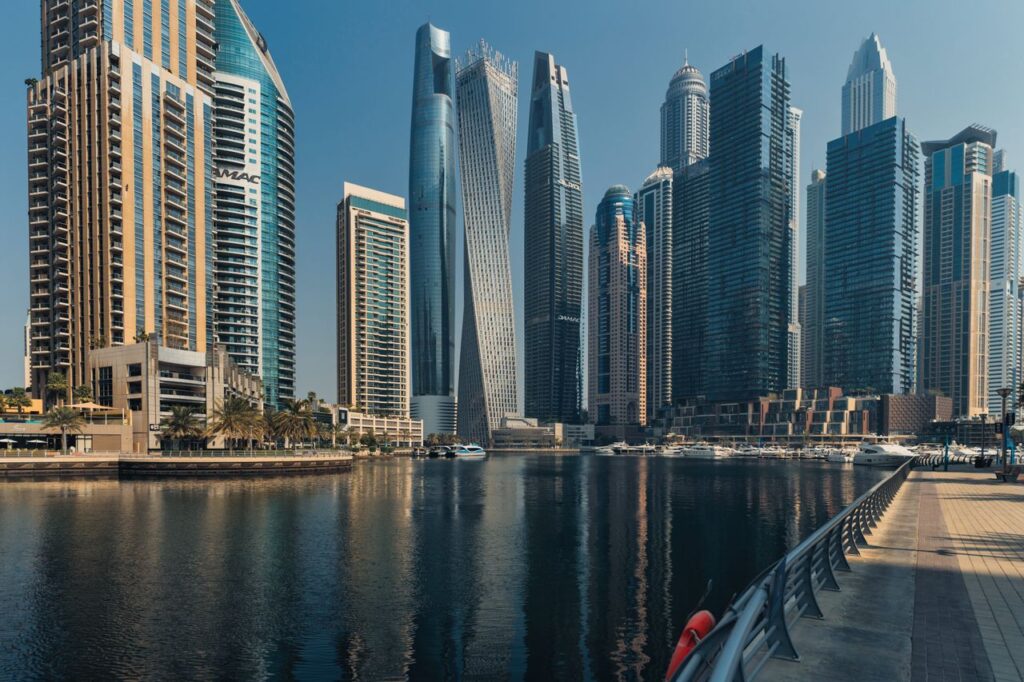
Dubai’s fintech ecosystem has grown quickly. The DIFC‘s combined AI, fintech and innovation community reached 1,933 companies in the first half of 2026, up 39% year on year.
An Emirates NBD and PwC report valued the UAE fintech market at approximately $3.16 billion in 2024, projected to reach $5.71 billion by 2029. Broader estimates that include all monetised fintech services put the market at about $52 billion in 2026 and on track to reach $90 billion by 2031, according to Mordor Intelligence, Regionally, fintech is where the money is going too: it accounted for $4.4 billion, or 58%, of the $7.5 billion raised by MENA startups in 2025, according toWamda.
That mix of licensed fintechs, global banks, brokers and trade finance houses helps explain why organisers are now running multiple, specialised financial services forums in the same city on the same day.
On 8 October 2026, the Kempinski Central Avenue in Dubai hosts three separate financial services events: the NextGen Payments & RegTech Forum, the Vision Forex Forum, and the Global Trade Finance Expo.
Payments, FX and trade finance rarely share a venue, let alone a date. The fact that they can here says something about the depth of the audience: enough banks, brokers and specialists are based in or doing business through Dubai to support three separate programmes in one building.
The figures above help explain why QUBE has put three specialist events on in Dubai on the same day. The agendas show what the organiser expects its audience to be discussing this autumn, while the growth in companies, funding and regulatory activity suggests those themes extend beyond the events themselves.
Why now, and why Dubai
The growth numbers explain scale, but not timing. Why are payments, FX and trade finance all having the same conversation about AI and compliance at once, and why is Dubai where that conversation is happening?
Start with the technology. One sector adopting AI while the others watched from the sidelines would be an ordinary hype cycle. This looks more like a single shift landing across financial infrastructure at once: payments, trading and trade settlement are different workflows, yet each is now being asked where automation can move faster without losing control, and each is showing up on a Dubai agenda making the same claim.
Then there is the regulator. The Central Bank of the UAE expanded its regulated perimeter in 2025, bringing open finance and certain payment services involving virtual assets formally within its scope, according to Chambers Practice Guides.
The DFSA’s tokenisation regulatory sandbox, under its Innovation Testing Licence regime, drew 96 expressions of interest from firms across the UAE, UK, EU, Canada, Singapore and Hong Kong, according to the DFSA. VARA and the Central Bank appearing as speakers at the NextGen Payments & RegTech Forum fits that pattern: these are regulators building the rulebook alongside the industry in real time, not after it has already moved.
That is what marks Dubai out from a merely “growing market”: the regulatory infrastructure went in ahead of demand, instead of catching up to it afterwards. A rising company count alone wouldn’t get a city to the point of hosting three specialist events in one day. The infrastructure is what does that, and it is why a regulator’s name on an events agenda here is worth flagging, not passing over as routine.
Between them, the three events have published speaker lists that include executives or representatives from Citi, Barclays, Deutsche Bank AG, HSBC GSC Cairo, Standard Chartered Bank, Santander, Mastercard, ACI Worldwide and Mashreq.
The Global Trade Finance Expo draws more than 50 speakers from organisations including First Abu Dhabi Bank Misr, ICIEC and National Bank of Kuwait. The NextGen Payments & RegTech Forum’s roster includes Accenture Middle East and Norton Rose Fulbright alongside the major banks and payment networks. The Vision Forex Forum brings in MultiBank Group, Equiti, HFM, FXCM, Vantage, Pepperstone and IG Group.
A shared theme, different roles
AI is a recurring theme across all three programmes, though its role differs by market. NextGen Payments frames it as part of the transaction stack itself, running sessions on “Building the AI-Powered Payments Stack” and “Agentic Payments.” Vision Forex links it to brokerage and execution, with “The AI-Powered Brokerage” and “Autonomous Trading Agents & The Future of Execution.” The Global Trade Finance Expo places it alongside digitisation and settlement, in a session on “Digital Assets in Trade Settlement, Tokenisation, Stablecoins, CBDCs.”
Compliance appears alongside the technology discussion across all three programmes. NextGen Payments covers AML/KYC and real-time fraud defence. Vision Forex has a session on “Fraud, Scams & Deepfakes.” The Global Trade Finance Expo is running sanctions and TBML detection sessions, including a dedicated stress-test tabletop exercise.
Regulators and industry bodies are also listed among the speakers: VARA and the Central Bank of the UAE appear on the payments programme, while ICC UAE, an industry and trade body rather than a regulator, is represented on the trade finance agenda.
The pairing isn’t a coincidence across three unrelated agendas. Each vertical is adopting the same automation technology, and each is being made to answer for the risk it creates on the same day, with a regulator’s name on the agenda in every case.
This goes well beyond a few vendors chasing the latest hype. It shows a market where regulators and companies are actively collaborating on rules as technology evolves, rather than scrambling to catch up long after products have launched.
For anyone weighing a UAE market entry, that timing matters more than the growth numbers alone. A single well-attended conference tells you a market has an audience, but three specialist conferences on one day, each drawing named global banks and each sharing a regulator on stage, reveals something deeper: the market is mature enough to sustain separate specialized tracks, and its regulatory framework is being actively shaped alongside this growth, rather than attached retroactively.
Fintechly readers can get a discount on tickets using code QUBE10.
Disclosure: Fintechly is a media partner for the NextGen Payments & RegTech Forum, the Vision Forex Forum, and the Global Trade Finance Expo.