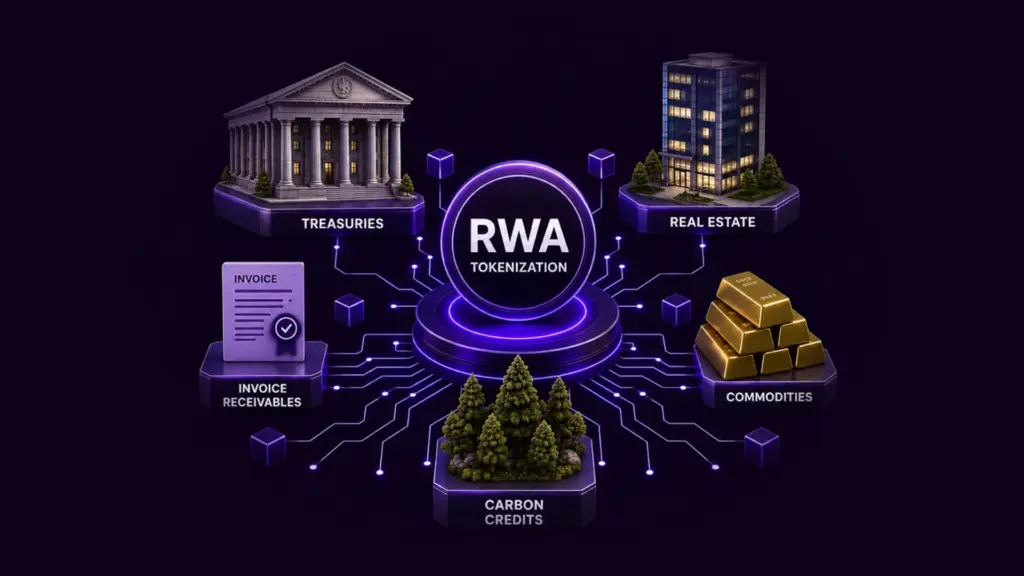
Fintech firms across the developing world say they are ready to tokenise real-world assets. Their regulators say almost nothing is happening yet. A new Cambridge study puts numbers on that split, and the numbers are wide.
Market participants in emerging markets rate their strategic priority for tokenisation at 4.5 out of 5 and their own organisational readiness at 4.4. Regulators in the same economies assess actual market activity at 2.1. The finding comes from Tokenised Assets: Pathways for Emerging Market and Developing Economies, published on 30 June 2026 by the Cambridge Centre for Alternative Finance (CCAF) with Financial Innovation for Impact and the UK’s Foreign, Commonwealth and Development Office.
The report draws on research across 23 emerging-market jurisdictions and more than 20 interviews with regulators and market participants.
“Our research points to a gap between market readiness and regulatory preparedness in emerging economies,” said Bryan Zhang, co-founder and executive director of the CCAF. “Institutions are prioritising tokenisation strategies, while regulators are still assessing how to engage. Their response will define whether tokenisation contributes to deeper, more inclusive capital markets, or creates new risks that go unsupervised.”
What the perception gap actually measures
The two sides are not disagreeing about whether tokenisation matters. Regulators score its strategic importance at 3.9 out of 5, close to industry’s own 4.5. The gap is about activity: a firm that believes it is ready to issue finds its plans held up by rules that have not been written and settlement infrastructure that does not yet exist in its market.
Tokenisation means issuing a claim on a real asset, a bond, a property, a commodity, as a token on a shared digital ledger rather than a conventional register. The report identifies four structures already in use: native issuance, custodial, collateralised and synthetic.
Why the two sides want different things
For market participants, the draw is access to capital. Tokenisation lowers the administrative cost of small offerings and automates compliance, a route to capital that conventional infrastructure has priced out. Regulators see it differently: financial sovereignty, keeping domestic capital from draining onto offshore platforms. Zhang’s point is that the two motives can align, but only if supervisors engage rather than wait.
Which assets move first
The asset classes the report expects to move first are those defined by illiquidity and high intermediation costs: real estate, public securities, fixed-income instruments and commodities.
The report cites Hong Kong Monetary Authority research finding that tokenised bonds cut underwriting fees roughly 25.8% and bid-ask spreads 5.3% against comparable conventional instruments. That helps explain why readiness scores so high while activity stays low: firms can see the saving, but not yet a supervised route to capture it.
The regulatory pathways are half-built
In most jurisdictions analysed, regulators have not set out how existing rules apply to tokenised instruments; where rules exist, they concentrate on primary issuance, leaving custody and post-trade activity under-specified.
The study groups responses into three approaches: extending securities frameworks, building bespoke cryptoasset regimes, and applying anti-money laundering registration. None alone captures the full lifecycle from issuance to redemption. Sandboxes remain the preferred testing mechanism, paired with cross-agency coordination in the strongest cases. Most emerging markets fall short of the report’s interoperability bar, the practical reason the activity score sits at 2.1.
The risks change shape rather than disappear
“Tokenisation does not simply replicate existing market risks in digital form, it changes them,” said Hugo Coelho, a research affiliate at the CCAF and director of policy and advisory at Financial Innovation for Impact.
Liquidity is the most stubborn risk, stuck in a loop where low activity discourages participation and weak participation suppresses activity further. Interviewees rated the lack of interoperability across competing networks the highest-severity risk at 3.93 out of 5, and legal uncertainty over token property rights and settlement finality compounds it.
What decides the outcome
The value of tokenised real-world assets on-chain grew almost fivefold in three years to around $24 billion by June 2025, according to CoinDesk, most of it in advanced-economy private credit and government debt. Emerging markets are the frontier the study argues could benefit most and are furthest from the infrastructure to do it safely.
The bottleneck is not industry appetite, which the data puts at the top of the scale. It is the regulatory, legal and settlement scaffolding that turns appetite into supervised activity, moving at institutional pace, not product-cycle pace.
The 2.1 that regulators assign to market activity today is the number to watch. Zhang said that number, and how fast regulators move it, will decide whether tokenisation deepens capital markets across the developing world or adds a layer of risk that outruns the people meant to oversee it.