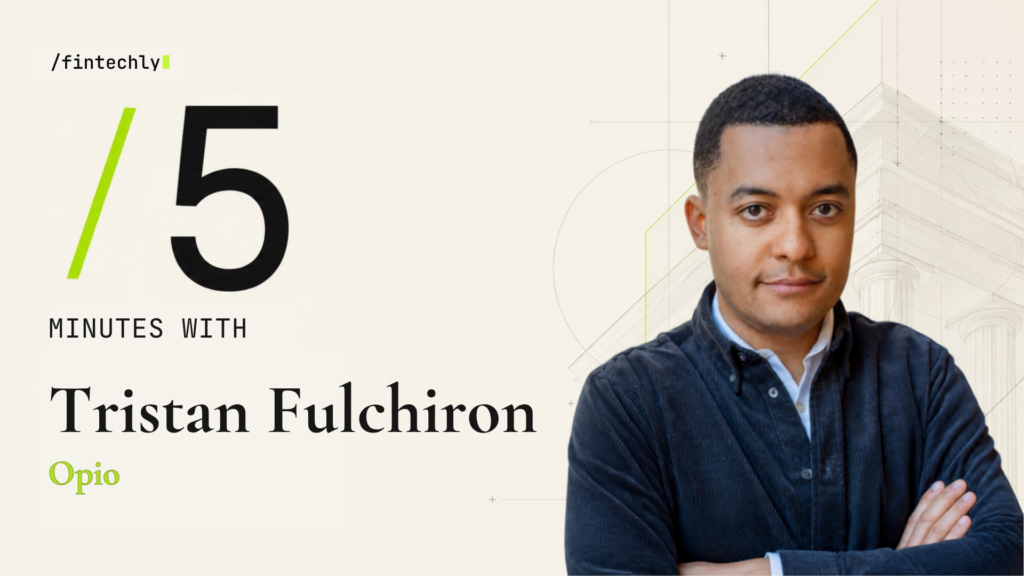
Opio co-founder and CEO Tristan Fulchiron on why AI’s job in financial due diligence is to do the groundwork, not replace the professional judgement at the centre of every deal.
Tristan Fulchiron co-founded Opio in 2025 to bring AI to financial due diligence. In this week’s Five Minutes With…, Fintechly speaks to Fulchiron about the wave of family businesses about to change hands, why AI in audit isn’t about replacing the professional, and what Europe’s political choices on AI mean for the industry ahead.
Can you tell us about yourself and what brought you to this point in your career?
I trained as an engineer at École Polytechnique and then spent the first part of my career as a civil servant, first in defence and then at the Ministry of the Interior, where I worked on major digital transformation projects.
What I learned there is that technology only creates value when it solves very concrete problems for the people using it. You can have incredibly powerful technology, but if it doesn’t fit the way professionals actually work, it won’t transform much.
One project we worked on illustrated this: If your iPhone was stolen or you had an issue with your car in France, you had to go to a police station and wait two hours to file a complaint.
We made it possible to do that online, meaning the complainant gains time and gets a reference number for their insurance; the police officer already has the complaint filled in, and if the bike or the phone turns up, they have a number to call back.
Today something like a third of complaints for damage to property are filed online in France.
Before the project, it was zero.
That is one of the ideas behind Opio, which I founded with Olivier Chancé in 2025. We saw a huge amount of innovation happening around generative AI, but relatively little focused on financial audit. It is a fascinating field for AI because it combines enormous amounts of data, complex analysis, tight deadlines and, crucially, professional judgement.
We decided to start with financial due diligence and build from there.
What problem or opportunity are you most focused on right now?
Opio is focused on Transaction Services, which is the team that performs due diligence before a company is acquired, and typically have only a few weeks to understand its true financial performance. They have to work through huge amounts of information, from financial statements and accounting data to contracts and payroll, and turn it into an assessment that can directly influence the price and terms of a transaction.
There is a huge amount of preparatory work involved, which technology can increasingly handle. But at the end of the process, you still need an experienced professional to understand the business, challenge management and interpret what the numbers actually mean. That balance is exactly what interests us. Due diligence is our starting point, not our end point. We believe the same approach can progressively be applied to other areas of financial audit, while keeping professional judgement at the centre.
My goal during my career has always been to change the way people work, and to give them more time to focus on where they bring real value. Nobody in this industry is going to tell you their added value is spending two hours of their Monday reconciling invoices with the general ledger. They want to spend that time on professional judgement, taking a step back on the company they are looking at, and advising the CEO or the CFO. It is the same thing I wanted for police officers who were losing half their time filling in a form.
What do you think deserves more attention than it is getting in your part of the industry?
The wave of family businesses that is about to change hands, and whether we have the capacity to handle it.
In France, you have many family businesses currently owned by people who are going to retire in the next two or three years. When you look at the number of M&A transactions we will have to face as a country, and you look at the people available to handle them, the arithmetic doesn’t work.
The generational part matters too. In a lot of these businesses the new generation simply does not want to go into the family business. So these businesses – tens of thousands of them – will be sold. But evaluating how much a company is worth is very, very hard and we are going to need more people – or enable people to work faster with AI.
If we don’t, the risk is either that people cannot sell their companies at all, or companies get bought on vibes more than on facts and financials, which means people will overpay and underpay. That’s not fair to anyone, and it makes the whole economy less efficient.
What do people most often get wrong about what your company does?
The biggest misconception is that AI in audit is about replacing the auditor. I think it is almost the opposite.
Take financial due diligence: Before an acquisition, professionals have to understand how a company is really performing. That means going through financial statements, accounting data, contracts and other documents, reconciling information and identifying what deserves further investigation. AI can take on a significant part of that preparatory work.
But it cannot sit across the table from a management team and understand the story behind the numbers. It cannot decide on its own which issue is material in the context of a transaction. And ultimately, it does not carry the professional responsibility for the conclusions. That is how we think about Opio. The technology should do more of the groundwork so that the professional can spend more time on the part of the job where human expertise matters most: analysis, judgement and client interaction.
What do you expect to rise up the agenda over the next year?
Europe has a series of important elections coming up this year, and how European governments position themselves on AI will be critical.
There was an exchange recently that should give us a lot to think about as French people. The US Treasury Secretary, Scott Bessent, was asked what was happening with AI in Europe, and he laughed out loud and said: “Nothing.”
AI is going to be a key part of the geopolitical power games, and right now nobody can honestly say it is anything other than the US versus China. What we all have to watch, as technologists and as people working in tech, is how these candidates and these new governments position themselves between those two powers. What conditions do we need to meet, as Europeans, to become relevant in the age of AI, given the reality of the technological ecosystem? I hope that will be a key item in the next political cycle.
What’s the one question about your company we should have asked, and what’s your answer?
“Why did you choose to start with financial due diligence?”
The answer is because it is almost a perfect test case for what specialised AI can bring to financial audit.
Transaction services teams work under enormous pressure and the stakes are very high, so people are far more attentive to anything that saves them time. If AI saves them five minutes, ten minutes, an hour at the start of a project, they are genuinely open to it, because the work is that intense.
There was also a technology bet. AI is fundamentally a technology trained on text, so it made sense to everyone that it would be good for lawyers, which is why you have so much legal tech at very high valuations. We believed before most people that it was also going to work for finance, for people who handle numbers day to day.
When we started, the models were much less reliable on that kind of data, and it was a challenge to convince people to just wait a little. With our engineering background it was very clear to us that the day was coming. It is happening right now: the models have become very good at accounting, and we leverage that.
A niche industry, very high stakes, and a real willingness to try new tools. That combination made it obvious we had to start with financial data.