

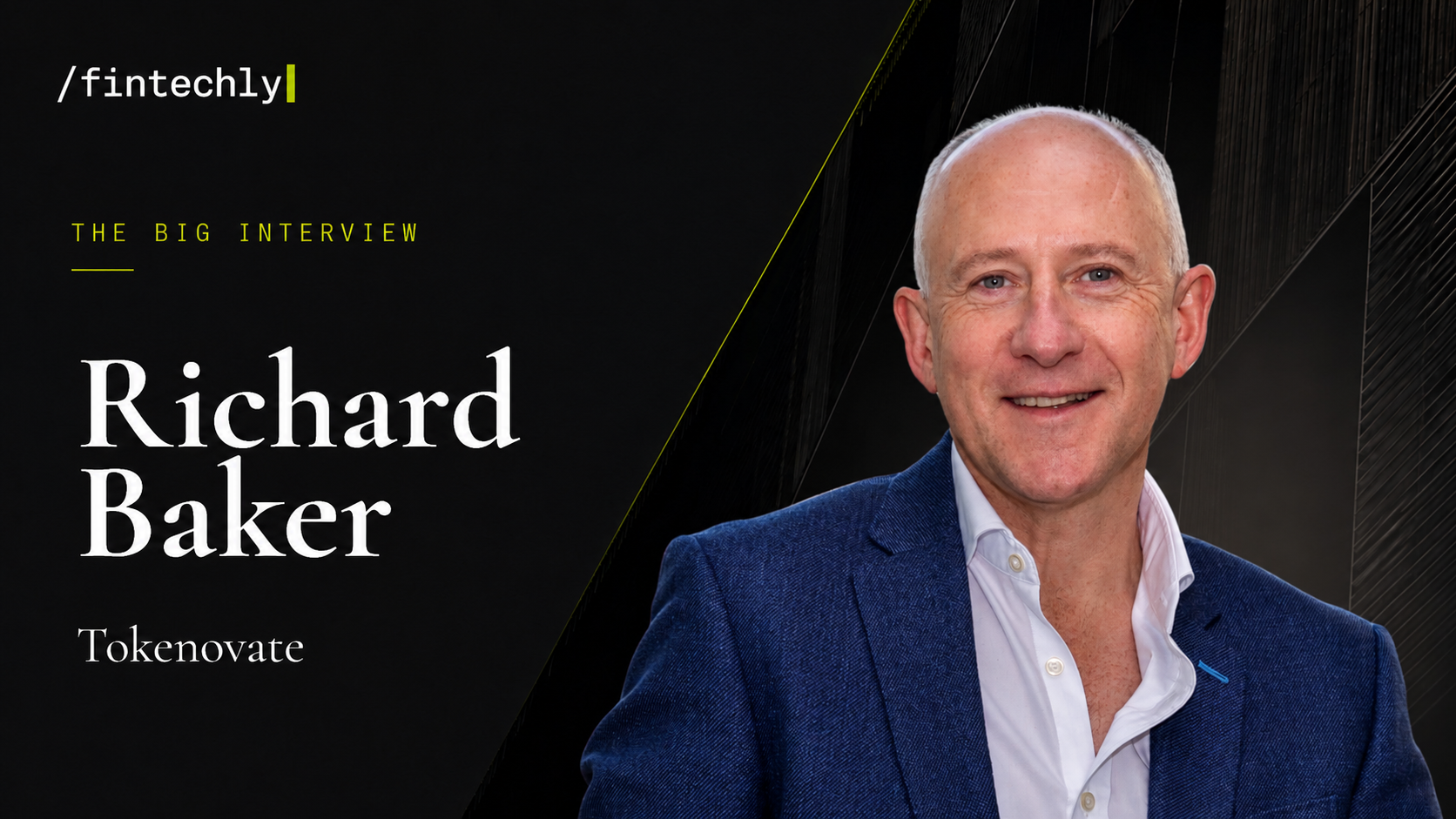
- Who
- Richard Baker, Founder and CEO, Tokenovate
- Background
- Telecoms engineer at Nortel Networks, then capital markets. Founded ClearTrade Exchange, the Singapore commodities-futures venue, which he built and later sold before turning to blockchain
- The venture
- Founded 2022. Post-trade workflow automation for tokenised OTC derivatives and securities financing, built on the industry Common Domain Model. Co-founder Gerard Banaszkiewicz is COO
- Status
- In production, not yet trading. Baker says customers go live in 2026. Live use cases: repo and derivatives
- Backing
- Baker says Tokenovate has raised about £18m since inception, anchored by a Swiss family office, and is raising a £20m Series A to close in Q4 2026
- The bet
- The unsolved problem in tokenised markets is secondary-market readiness, not issuance
KEY TAKEAWAYS
- 01 Tokenovate automates the post-trade lifecycle for tokenised derivatives and repo, built on the Common Domain Model, the ISDA, ICMA and ISLA standard that expresses legal agreements as code rather than reinventing them on-chain.
- 02 It has rare institutional backing: one of 54 firms in the UK's new wholesale-tokenisation taskforce and one of 18 in the Bank of England's synchronisation lab. It is in production, with the first customers due to go live in 2026.
- 03 The bet is deliberately chain-agnostic: a routing layer above the roughly twenty networks now fragmenting tokenised markets, moving assets between them rather than backing one chain to win
That code is Richard Baker’s answer to the problem the hype keeps missing: issuing a digital asset is easy; making it tradeable and still intact in thirty years isn’t. The plumbing is built. Trading is ready to start.
The set piece of tokenised finance is a government issuing a digital bond. It photographs well, it leads every announcement, and Richard Baker thinks it’s the least interesting thing in the room.
“The issue for the world and the market is not the issuance,” he says. “It’s, is that issuance secondary-market ready?” Anyone can mint a digital bond. The question Baker keeps asking is what you can do with it the next morning.
Can you pledge it into a ten-year interest-rate swap? Post it as collateral? Move it, settle it, and trust that the record of who owns it survives the full life of the trade? That gap, between an asset existing and an asset working, is what Tokenovate was built to close.
The company he founded in 2022, split between London and Cambridge, automates the post-trade lifecycle for tokenised derivatives and repo. Baker came to it the long way round: fifteen years in telecoms engineering at Nortel, then a commodities-futures exchange, ClearTrade, that he built in Singapore and sold in 2016. “I think about the world through the lens of value chains and life cycles,” he says.
Tokenovate came out of the part of markets he found most broken: post-trade, the unglamorous gap between agreeing a trade and settling it. Around exchanges and clearing houses he had watched operations teams spend their days there, chasing data, reconciling and repairing trades by hand.
He got into blockchain in 2016 thinking it might fix that. Looking again in 2021, he found the industry had spent five years pouring money into front-office technology and leaving the back office untouched. So he built the thing that would.
The payoff, if it works, is speed. When a trade settles in tokenised form the collateral behind it can move far faster, freeing up balance sheet that would otherwise sit idle waiting to settle.
Baker’s example is repo: move a tokenised bond in and out at higher frequency and lower friction, and the money behind it works harder. That is why repo is where the first real demand is showing up.
The part that has to survive the transition
Tokenovate’s answer isn’t to invent a new legal framework on a blockchain. It takes the one the market already trusts and runs it as code. The platform is built on the Common Domain Model, the shared standard that ISDA, ICMA and ISLA agreed to develop jointly in 2021, which turns the master agreements underpinning derivatives, repo and securities lending into machine-readable logic.
“You don’t go off right now and start to build on a blockchain and invent all of that from scratch,” Baker says. “The forty-year history of how those legal agreements underpin the current makeup of those global markets is now built into our platform.” It’s the strongest part of the case: not a claim about technology, but about not throwing away the legal scaffolding the market runs on.
What is still ahead is live volume. Tokenovate is in production, and Baker says the first customers go live this year, running repo and derivatives across the platform. The technology and the standards are built; the milestone in front of him is the one every infrastructure company reaches eventually, the first counterparty putting a real trade through it.
A map, not a territory
Baker’s second bet is bolder. Tokenovate isn’t building on a blockchain at all. It builds above all of them.
His argument starts with a failure. When banks first took blockchain seriously, they each built their own private chain, JP Morgan’s, Broadridge’s, and dozens more. “They’ve built their own kind of lily pads in a big pond,” Baker says. “They’re all presenting differently and nothing really interoperates.” No bank was ever going to settle the market on a rival’s coin, and the private chains couldn’t talk to each other.
He reaches for an older analogy: “It’s the VHS, Betamax story. Betamax was the better technology, but VHS won market adoption.” He counts roughly twenty networks now fragmenting global capital markets, with JP Morgan’s Kinexys, Broadridge’s Distributed Ledger Repo, and the Digital Asset-built Canton Network among them.
So Tokenovate positions itself as the routing layer above the playground, agnostic to which chain wins. Baker calls it Google Maps for financial instruments: whatever the asset and whatever chain it lives on, the platform finds the route and moves it.
It is a clever place to stand while the market is split, and split is exactly what it is, a live field of competing networks with no winner in sight. His bet is that the routing problem outlasts the network wars, and the wars show no sign of ending soon.
Inside the institutions
For a four-year-old, Tokenovate has got remarkably close to the institutions that will decide whether any of this happens. It spent three years on the standards with ISDA, ICMA, ISLA and the Investment Association.
It is one of 54 firms in the UK’s new Wholesale Digital Markets Champion taskforce, chaired by Chris Woolard, whose first focus is tokenised repo, and one of 18 in the Bank of England’s Synchronisation Lab, testing how the renewed RT2 settlement system carries the cash leg when securities move on-chain. The regulatory groundwork is there too: the Property (Digital Assets etc) Act received Royal Assent in December 2025.
That is a rare amount of institutional trust for a company this young to have earned, and it is the moat as much as the code is. The firms Baker needs as customers are the same ones already sitting around these tables with him.
The question Baker keeps coming back to is the long horizon, one the hype rarely asks. “If I issue a digital bond that is a thirty-year instrument, am I going to be putting that on a technology layer that will actually be here to settle it in thirty years?” On the cash side he is specific in a way that lines up with the rest of the market: not crypto, but stablecoins, as the settlement leg.
The industry still has to move, and conservative markets move slowly. But the demand Baker describes, for plumbing that outlives the trend, is real, and he has spent thirty years building exactly this beneath markets. This time he has wired the industry’s own legal rulebook into it. If tokenised finance needs a layer that makes it trade, few have thought longer about what that takes.