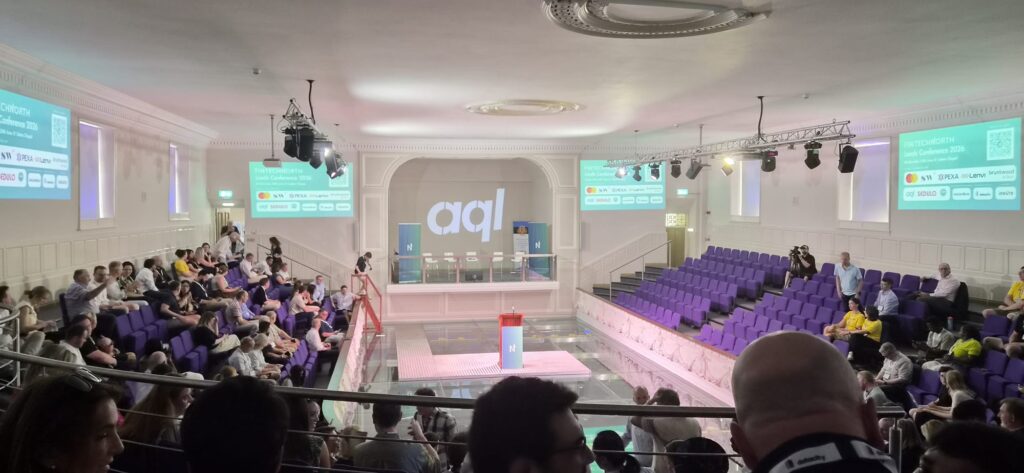
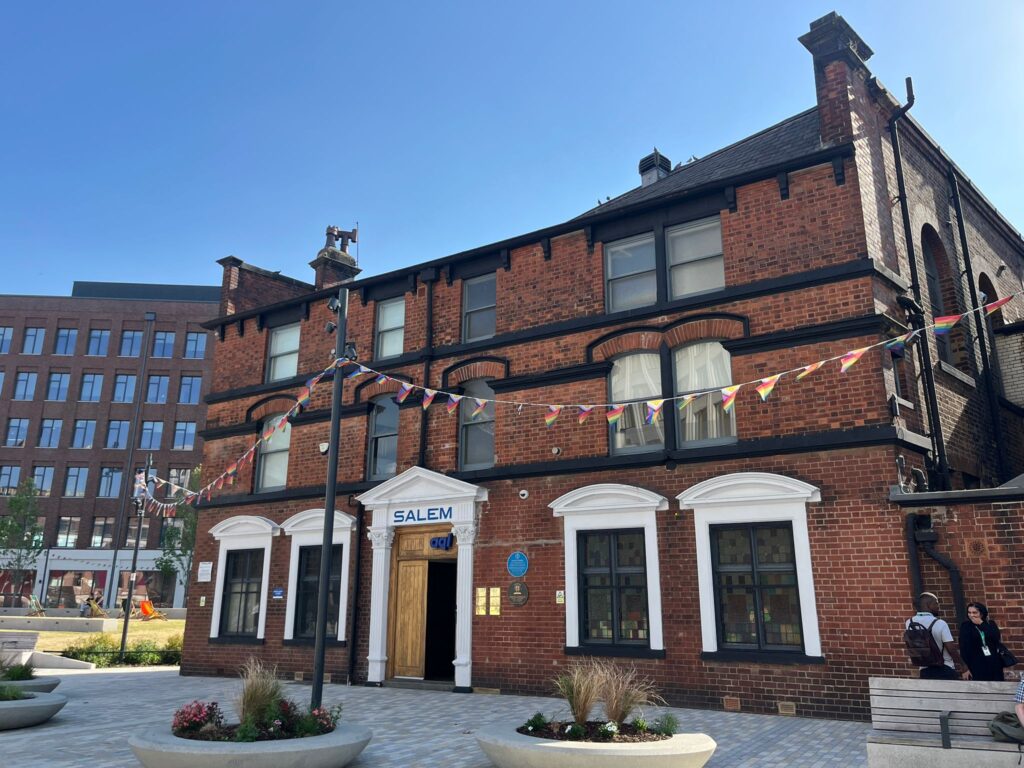
FinTech North marked its tenth anniversary back where it began, bringing founders, regulators, banks and public bodies to Salem Chapel, HQ of aql, this week to consider how far the Leeds fintech ecosystem has come – and where it goes next.
The conference took place on one of the hottest days of the year, with Leeds under an amber heat warning and temperatures heading beyond 30C. Organisers had worked overnight to cool the listed building, but there were plenty of shorts, improvised fans and cries of “isn’t it warm?”, along with some tactical gathering in the one downstairs room that appeared to have air conditioning.
Richard Carter, CEO of lending technology company Lenvi, could not resist the obvious line, recalling that Leeds was “hot for fintech” a decade ago and that, on the day of the anniversary conference, fintech was quite literally hot in Leeds.
Inside Salem Chapel, delegates sat above a working data centre visible through the auditorium’s glass floor. Outside, a plaque marks the spot where Leeds United was founded in 1919, following the disbandment of Leeds City over financial irregularities. With representatives from the Financial Conduct Authority and Bank of England keeping a watchful eye inside, there was little chance of any repeat financial shenanigans.
The mood across the morning was largely celebratory. Leeds now has a deeper fintech community, a growing concentration of regulators and public institutions, and a stronger claim to national and international attention than it did when the conference first met.
But discussion also turned to the next stage: concerns over encouraging more firms to scale from Leeds, attracting investors and experienced leaders into the region, and making sure that local founders can draw on the support they need without automatically looking south.
A decade of growth
West Yorkshire is now home to 94 fintech firms, while the Leeds City Region’s fintech ecosystem contributes an estimated £700 million a year to the economy.
Around 60 national and international companies have chosen the region as a base for their UK operations. The FCA, Bank of England and National Wealth Fund have also expanded their presence in Leeds.
Simon Morley, head of the Bank of England’s Leeds office, said it would employ at least 500 people in the city by the end of 2027, representing around 10 per cent of the institution.
“We are not creating a back office or a satellite branch,” he said. “What we are doing in Leeds is what we do in London: central banking, just delivered from the North of England.”
The office has been expanded to include space for governance meetings and banking and payments operations. Morley also addressed the involvement of Leeds City Council and technology company Aire Logic in the Bank’s Digital Pound Lab, as well as regional representation in discussions about the UK’s next generation of retail payments infrastructure.
West Yorkshire Mayor Tracy Brabin pointed to that mix of businesses, public institutions and university expertise when making the case for the region.
“When the question comes, ‘Why West Yorkshire?’, my answer is simple: look who is choosing us,” she said.
Brabin highlighted GoCardless, which opened its northern hub in Leeds last year with a commitment to create 50 jobs in its first 12 months. She said 37 people had already been recruited, with further vacancies open.
The region also has seven universities, more than 110,000 students and around 17,000 graduates in science, technology, engineering and mathematics subjects each year.
Brabin described West Yorkshire as the City of London’s “younger, funky sibling”, while also presenting it as a serious alternative for financial services firms looking beyond the capital. She also touched on the recent launch of Tech West Yorkshire, which will bring together technology companies, universities, investors, entrepreneurs and skills providers across the region.
Carter said the change over the past decade could be seen in where founders now choose to establish their businesses.
“Ten years ago, people would go down to London to set up their businesses,” he said. “Now people stay in Leeds to set up their businesses. In 10 years’ time, I’d like to see people moving from London to Leeds to create those businesses because the infrastructure is here.”
More support for scaling
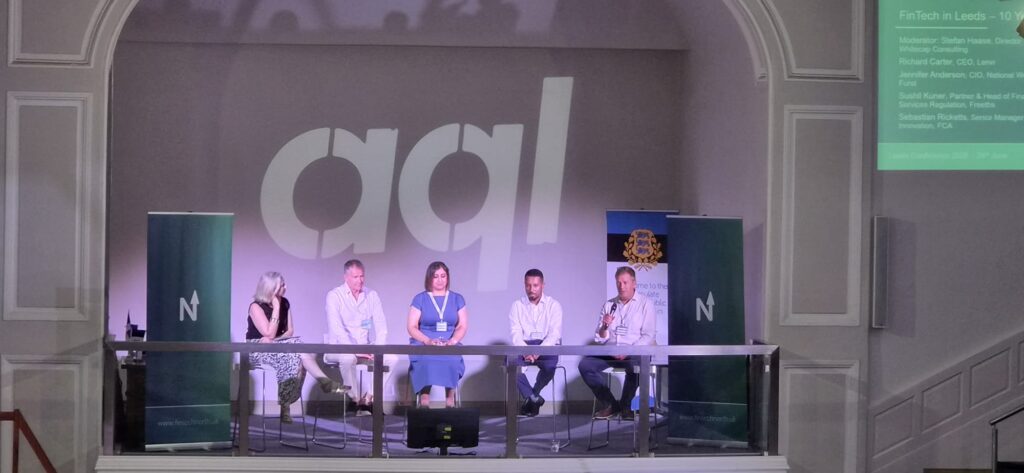
Speakers were less united over whether founders still need London once their companies begin to grow.
Jennifer Anderson, chief investment officer at the National Wealth Fund, said the government’s decision to base the organisation in Leeds recognised the financial services expertise already available in the region.
Leeds offered a lower-cost base, a skilled workforce and strong links with universities, she said. The National Wealth Fund had combined local recruits from sectors including retail banking and insurance with people commuting from London, adding to the range of experience available in the city.
However, she said founders could still struggle to find the full package of support needed to move from a small business into a larger company.
“I do think it has come a long way, but the reality is that people need to be in London to scale up their organisation. I spent many a train journey going down to London trying to pitch to incubators, and that’s where we were successful. It would be great to get some big incubators here helping startups and giving them that wraparound support.”
That support, she added, went beyond capital to include help with regulation, premises and the practical demands of expanding a business. Anderson hoped that, by FinTech North’s 20th anniversary, more incubators and private equity firms would have established themselves in the region.
“That 7am train from Leeds to London is always full,” she said. “Let’s have the 7am from London to Leeds full.”
Sushil Kuner, partner and head of financial services regulation at law firm Freeths, offered a somewhat different view. She said investors were more interested in the quality of a company and its regulatory position than its postcode.
“I don’t think they look at geography,” she said. “They look at the business model, the regulation around it and the due diligence they undertake. As long as it is a sound business model, they are willing to look at it.”
The difficulty was often reaching the right investors rather than convincing them to back a northern company, she added.
Stefan Haase of Whitecap Consulting admitted that the region’s advisers also had a part to play. He regularly travelled to London to meet private equity firms, wealth funds and family offices, rather than asking more of them to come to Leeds.
“We should stop doing that,” he said. “I should stop doing that.”
The next phase of open banking
The 10-year theme continued in a discussion on open banking and payments, which is approaching a similar milestone.
“We’re about a decade in, or just under a decade in, with open banking,” said Angela Yore, CEO of communications agency SkyParlour and a member of the Payments Association’s advisory board, as she chaired the panel. She described the sector as moving into its “teenage years”, with the next stage expected to bring faster change.
Much of the conversation focused on the infrastructure beneath those services. Nick Davey, head of strategy at Open Banking Limited, said even the UK’s most modern bank-payment system was around 20 years old and due an upgrade. The question was how its replacement would work alongside the account-to-account payment services already being developed through open banking.
Attention then turned to the UK Payments Initiative, an industry-owned company developing commercial recurring account-to-account payments. Tom Burton of bank payments company GoCardless summed up one of its more immediate problems: “We’ve created the first new payment scheme in the UK for 20 years, and we haven’t given it a name.”
Burton said he favoured ‘Recurring Pay by Bank’, although the industry had yet to agree how the service should be presented to customers.
Chris Sier remembered
FinTech North also paid warm tribute to Chris Sier, the former chair of FinTech North, who died in November 2025.
Peter Cunnane, director of international and partnerships at industry body Innovate Finance, delivered the first Chris Sier Keynote in his socks. Sier had done the same when he spoke from the Salem Chapel stage at the first FinTech North conference in 2016.
Cunnane first met Sier at a Leeds financial services event in 2013, before fintech had become part of his own professional vocabulary.
“Chris immediately called at me to make the case for Leeds and its financial services,” he recalled. “I was initially intimidated. Chris could be quite a force of character, but I quickly warmed to his enthusiasm for innovation and his humour.”
Sier persuaded him to stay for coffee, introduced him to contacts across the city and secured a contribution to a report supporting the Leeds financial services sector before he returned to London.
He went on to challenge ministers, regulators and industry groups, including Innovate Finance itself, over whether they were doing enough to support fintech across the UK.
“We all know that Chris would take off his shoes and tread lightly over this particular stage,” Cunnane said. “But anyone who heard Chris speak can agree that he never tread lightly when it came to challenging the industry and decision-makers.”
Cunnane said the sector should not assume that the work of supporting regional fintech had been completed.
“Never rest on our laurels that we have done enough to support fintech in Leeds, Manchester, Liverpool, Newcastle or, indeed, even in London,” he said.
Cunnane said the progress made over the past decade should not obscure the work still to be done. Regulatory and investment challenges remain, while the industry also needs to move more quickly to make use of artificial intelligence.
He urged founders, regulators and decision-makers to be honest about where further work was needed rather than treating the sector’s past success as enough.