
Agentic AI’s been a hot topic among banks and fintechs, and the momentum doesn’t seem to be slowing. A report by MIT Technology Review, “Reimagining the Future of Banking with Agentic AI,” showcased why organisations need to mitigate risks and overcome operational challenges to truly hit the mark in the transformational potential for agentic AI in banking.
Agentic AI’s possibilities in banking are endless. It could respond to customer requests, automate loan approvals, and even extract key terms and conditions a consumer would like to better understand from financial agreements.
Specific use cases come to mind, ranging from mortgage underwriting to loan collections and anti-money laundering requirements.
According to the report, over 50% of banking executives surveyed expect to see future gains, including improved fraud detection, better employee experience, reduced cost and increased efficiency.
Agentic AI Is Already Reshaping the Banking Floor
A 2025 survey of 250 banking executives by MIT Technology Review Insights found that 70% of leaders say their firm already uses agentic AI to some degree, whether through live deployments (16%) or pilot projects (52%).
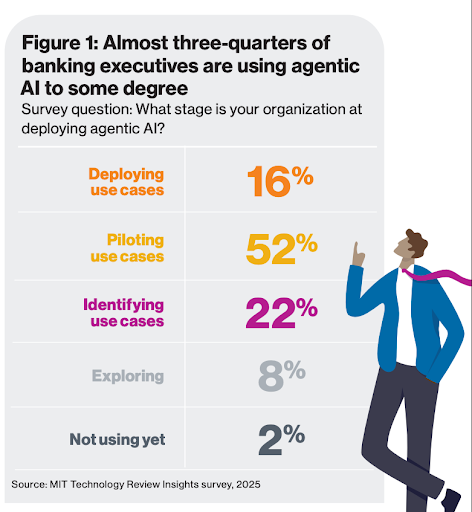
Image credit: Reimagining the Future of Banking with Agentic AI, MIT Technology Review
The technology is also proving its worth across a range of functions. More than half of executives rate agentic AI systems as highly capable of improving fraud detection (56%) and security (51%), while strong use cases also include reducing cost and increasing efficiency (41%) and improving the customer experience (41%).
On the ground, the most promising applications span mortgage underwriting, small business loans, collections, disputed transactions, and “know your customer” and anti-money laundering requirements.
In risk and compliance specifically, banks are deploying agentic AI to continuously monitor employees, customers, and potential bad actors. These include those using deepfakes or other AI-powered methods to impersonate customers and commit fraud.
Handling this work automatically lightens the load on human reviewers, freeing them to focus on the higher-risk, higher-complexity cases that need human judgment.
Executives expect the gains to compound: more than half anticipate further improvements in fraud detection (75%), security (64%), and the customer experience (51%).
How Do Organisations Overcome the Challenges of Deploying Agentic AI?
In order to fully capture the rewards associated with agentic AI’s potential, there are select obstacles businesses must overcome.
Zoom in on Compliance, Risk, and Governance
The report indicated that the top challenge cited by respondents involved creating value from agentic AI. 63% of respondents shared that this involved managing risk, compliance and governance confidently.
Organizations have to implement their respective guardrails, especially given that there are no firm regulatory standards currently in place.
Closing the Skills Gap Is Only Half the Battle
The second most common challenge, cited by 58% of the executives surveyed, is a shortage of technology skills and capabilities.
Firms face a dual task here. The first involves training the workforce to use AI systems effectively, which also helps overcome internal resistance to adoption. At the same time, businesses must balance the scale by demonstrating enough ROI to win over sceptical C-suites.
Legacy Data Systems Strain Under Agentic Demands
Poor data quality and integration ranks as the third-biggest challenge for the banking executives surveyed, flagged by 54% of respondents.
Large financial institutions typically run hundreds of existing data systems, and each one needs reliable linkages or application programming interfaces (APIs) before an agent can execute a response.
Role-based access controls and security protocols are non-negotiable, according to the report, and they serve a protective purpose too. They can stop a system from learning something it shouldn’t, based on the role it has been assigned.
Future-Proofing Against a Moving Target
The relentless pace of change adds another layer of difficulty. New AI models and platforms now ship every three to six months, and sometimes faster still. This can leave executives uncertain about how to future-proof the technology investments they commit to today.
Trust Remains the Hardest Currency to Earn
Perhaps the toughest challenge of deploying AI in the high-stakes world of financial services is trust.
In a recent EY survey, just 42% of respondents said they would trust financial services companies to manage AI in ways that align with their best interests, while 30% said they would actively distrust them to do so.
That gap leaves a net trust score of only 12%, one of the lowest levels among all the industries studied. Agentic AI looks unlikely to shift that dynamic for now: only 14% of respondents in the survey expect their firm to see trust as an outcome of agentic AI.
Cybersecurity Investment: The Trust Dividend
Investing in cybersecurity could possibly be one of the most effective ways to build that trust. An earlier MIT Technology Review Insights survey found that 40% of executives in regulated industries believe effective security practices can strengthen confidence in agentic AI.
And the benefits of cybersecurity contribute to the bottom line, too. A 2025 study by EY found that it can add between 11% and 20% in value, or a median of $36 million, to each enterprise-wide initiative it is involved in.
How to Effectively Capture the Agentic AI Opportunity
Adopting an emerging technology like agentic AI is rarely simple, but it doesn’t have to happen all at once. Organisations can start with a simpler agentic system that addresses part of a process, then scale it over time to automate progressively larger portions.
Targeted areas of customer service lend themselves particularly well to this approach as the technology matures and institutions grow more proficient at adapting agents to their existing governance guidelines and frameworks.
Organisations can take a few steps to ensure agentic AI delivers meaningful improvements. The first is to establish a robust governance framework, building AI systems in a way that keeps them firmly within the firm’s risk tolerance, which typically means maintaining a detailed inventory of AI systems tied to business owners, model documentation, and risk classification.
Equally important is prioritising use cases with clear business value, evaluating each one against the revenue, cost, or efficiency gains it is expected to generate.
For larger institutions, creating common platforms and capabilities prevents fragmentation, allowing data scientists, machine learning experts, and software engineers to build systems that are easier to govern, scale, and monitor safely.
Underpinning all of this is a focus on data quality and accessibility. Think of a single source of truth, clear data lineage, and consistent formatting and contextual standards that can serve a variety of use cases.
Just as critical is the human dimension. For now, agentic AI is best understood as augmenting people rather than replacing them, handling the more routine tasks while humans retain oversight and take the final decision.
Greater autonomy will come gradually rather than as an overnight switch. To get there, organisations will need to invest heavily in reskilling, recognising that even experienced staff must learn how to build, supervise, and use AI tools responsibly.