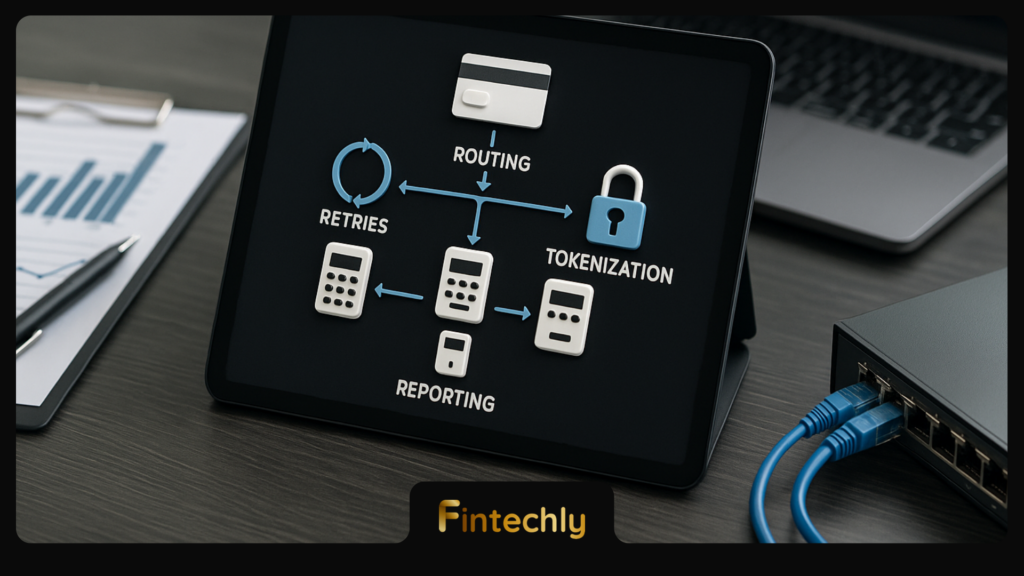
Payment orchestration is the layer that connects your checkout to multiple payment providers, then decides what should happen for each transaction. If you are still asking what is payment orchestration, think of it as a “traffic controller” for payments. It routes payments, retries failures, secures card data, and pulls reporting into one place.
This matters because payments rarely fail for one simple reason. Banks decline. Networks time out. Fraud tools block good customers. Or a provider goes down. Orchestration helps you recover revenue while keeping the customer experience smooth.
Payment orchestration, in plain terms
A payment orchestrator sits between your business (website, app, POS, or platform) and the providers that move money. Those providers can include PSPs, gateways, acquirers, alternative payment methods (APMs), and fraud or identity tools.
Instead of building and maintaining a separate integration for every provider, you integrate once. Then you manage routing rules, fallback logic, and data in a central place.
Simple definition: Payment orchestration is software that helps merchants connect to many payment services and choose the best path for each payment in real time.
Why merchants use payment orchestration
Most teams adopt orchestration for three goals: higher approval rates, lower cost, and less operational work.
- Lift authorisation rates: Send each transaction to the provider most likely to approve it.
- Reduce payment downtime risk: Fail over to another provider if one has an outage.
- Lower fees: Route based on blended cost, scheme fees, or regional acquiring.
- Speed up launches: Add new payment methods without a full rebuild.
- Unify data: Get cleaner reporting across providers and geographies.
The core building blocks (with real examples)
1) Smart routing (send each payment to the best provider)
Routing means choosing where to send a transaction. The decision can use many signals. For example: country, currency, card type, BIN range, risk score, payment method, or provider performance.
Example: Global e-commerce brand
A fashion retailer sells in the UK, EU, and US. UK cards perform best with Acquirer A. EU cards approve more often with PSP B. US cards are cheaper with PSP C.
With orchestration, the retailer sets rules like:
- Use local acquiring where possible.
- Prefer the provider with the best approval rate for that region.
- Cap volume to reduce dependency on one provider.
This is also why many teams track broader payment orchestration trends. Routing decisions change as markets, fees, and customer payment habits shift.
2) Retries and fallback (recover payments that fail)
Retries are not just “try again.” Good orchestration uses controlled logic. It can switch providers, adjust parameters, and time retries to match issuer behaviour.
Example: Subscription SaaS
A SaaS company runs monthly billing. A portion fails due to soft declines. Some succeed on a different acquirer. Others succeed if retried a day later after a customer gets paid.
Orchestration can run a playbook like:
- First attempt: Provider 1 (lowest cost).
- On soft decline: retry with Provider 2 (higher approval rate).
- On insufficient funds: schedule retry in 24–48 hours.
- Stop after a set limit to avoid extra fees and network penalties.
3) Tokenization (reduce exposure to card data)
Tokenization replaces sensitive card data with a token. The token can be stored and reused, while the real card number stays protected in a secure vault.
Example: Marketplace with saved cards
A marketplace stores cards for faster checkout. It also needs to pay out sellers. Orchestration can keep payment tokens consistent across providers. That makes it easier to switch acquirers without asking customers to re-enter card details.
Tokenization also supports security and compliance goals. If you handle card data, you should align with guidance from the PCI Security Standards Council (PCI SSC).
4) Reporting and analytics (one view across providers)
When payments are split across providers, reporting often becomes messy. Chargebacks, refunds, fees, and settlement timings sit in separate dashboards.
Example: Omnichannel retailer
A retailer takes in-store and online payments. It uses one provider for POS and another for e-commerce. Teams struggle to answer basic questions like:
- Which provider has the best approval rate this week?
- Which decline reason is growing fastest?
- How long does settlement take by country?
- What is the true cost per transaction after fees?
Orchestration helps standardise events and fields. It makes it easier to compare providers and spot issues early.
How payment orchestration works (step-by-step flow)
Here is a simple end-to-end flow.
- Step 1: Customer chooses a payment method at checkout.
- Step 2: Orchestrator checks rules (region, currency, risk, provider health).
- Step 3: Orchestrator sends the transaction to the chosen provider.
- Step 4: If it fails, orchestrator can retry or route to a fallback provider.
- Step 5: Orchestrator logs outcomes and normalises data for reporting.
What to look for in a payment orchestration setup
Not every merchant needs every feature. But these checks help.
- Provider coverage: Cards, wallets, bank payments, local methods, and payout rails.
- Routing controls: Rules, A/B testing, caps, and provider health monitoring.
- Retry logic: Smart retries, limits, and clear audit trails.
- Token strategy: Provider tokens vs network tokens vs an independent vault.
- Data quality: Clean schemas, export options, and fee visibility.
- Security: Strong access control, logging, and secure API design.
Security matters because orchestration adds another integration surface. It is worth reviewing guidance on payment orchestration API security so you do not create new weak points while trying to simplify your stack.
Common merchant scenarios (quick snapshots)
Scenario A: Cross-border brand improving approvals
A DTC brand expands into two new countries. Approvals drop because it uses one acquirer in a different region. Orchestration adds local acquiring and routes by country. Approval rates rise. Support tickets fall.
Scenario B: Flash sale protecting uptime
A retailer runs a limited drop. One provider slows down. Orchestration detects latency and shifts volume to a second provider. Checkout stays live during peak traffic.
Scenario C: High-risk category managing fraud and false declines
A digital goods seller uses strict fraud rules. Good customers get blocked. Orchestration can send higher-risk traffic to a stronger fraud tool, while low-risk traffic goes through a lighter flow. That reduces false declines.
Key metrics to measure orchestration success
Track a small set of numbers. Keep them consistent across regions and providers.
- Approval rate (authorisation rate): Approved / attempted.
- Recovery rate: Payments saved via retries or fallback routing.
- Cost per successful transaction: Fees divided by approved volume.
- Chargeback rate: By provider, method, and region.
- Provider uptime and latency: Real user impact at checkout.
For broader industry context, the BIS Committee on Payments and Market Infrastructures work on payment systems is a useful reference point for how payment rails and participants fit together.
FAQs
Is payment orchestration the same as a payment gateway?
No. A gateway usually connects you to one provider stack. Orchestration is designed to manage multiple providers and apply routing, retries, and unified reporting across them.
Do small merchants need payment orchestration?
Some do, many do not. If you sell in one country, with one method, and you have stable performance, a single PSP may be enough. Orchestration becomes valuable when you scale, expand globally, or need redundancy.
Will orchestration always increase approval rates?
Not automatically. You need good routing rules, clean data, and regular testing. Poor retries or messy rules can even reduce performance.
What is the biggest mistake teams make?
Routing only on cost. Cheaper routes can have lower approvals. The best setup balances cost, approvals, and customer experience.
Final takeaway
Payment orchestration helps you run payments like a system, not a set of disconnected tools. It gives you routing, retries, tokenization, and reporting in one layer. With the right rules and metrics, it can boost approvals, reduce downtime, and make expansion easier.